



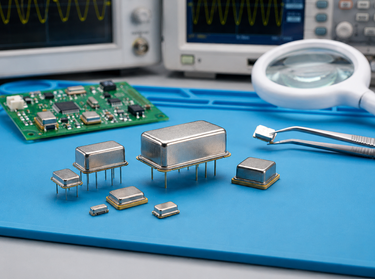
An Essential Guide to Crystal Oscillators: Functions, Types, and Applications
Every reliable electronic system requires a precise heartbeat, a continuous timing signal that dictates how well the entire circuit processes data and communicates. When you are designing a complex piece of hardware, selecting the right timing component is critical to the overall integrity of the design. At the foundation of most stable timing solutions is the crystal oscillator. While engineers sometimes treat these timing components as simple, plug-and-play devices, the underlying materials and specific electrical variations dictate system stability under environmental stress. Selecting the wrong component can lead to communication dropouts, data corruption, and system failures. So, how exactly do you determine which frequency control solution is right for your specific hardware project?
Core Operating Principles of Quartz Oscillators
To understand how these components dictate system timing, it is necessary to examine the physical behavior of a quartz resonator. The fundamental principle at work is the piezoelectric effect. When mechanical stress is applied to a precisely cut piece of quartz, it generates a proportional electrical charge across its surface.
Conversely, when an alternating electrical field is applied to the quartz, it physically deforms and vibrates. By placing the quartz inside a feedback loop of an amplifier circuit, the system naturally locks onto the mechanical resonant frequency of the crystal. This continuous conversion between electrical energy and mechanical vibration produces a highly stable, repeating waveform—typically a sine wave or a clipped sine wave—that serves as the clock signal for microcontrollers, processors, and communication chips.
The exact frequency at which the quartz vibrates is determined by the physical dimensions of the crystal blank, specifically its thickness, and the angle at which it was cut from the original quartz bar. The industry standard AT-cut, for instance, provides an excellent balance of frequency stability across a wide operating temperature range. As the crystal thickness decreases, the resonant frequency increases. However, there are physical limits to how thin the quartz can be manufactured before it becomes too fragile. For much higher frequencies, engineers utilize overtone modes, driving the crystal to vibrate at odd-integer multiples of its fundamental frequency. This physical and electrical resonance is what allows a quartz resonator to achieve a quality factor (Q factor) vastly superior to standard LC or RC oscillator circuits, resulting in minimal phase noise and exceptionally low jitter.
Five Primary Classifications of Crystal Oscillators
When specifying a timing solution, the choice heavily depends on the required frequency stability, power consumption constraints, and environmental operating conditions. To make informed decisions, it is helpful to compare the different crystal oscillator types side-by-side before exploring their specific mechanisms.
| Oscillator Type | Frequency Stability | Power Consumption | Relative Cost | Primary Use Case |
|---|---|---|---|---|
| XTAL | Moderate (±10ppm to ±50ppm) | Very Low (External) | Lowest | Basic microcontrollers, consumer electronics |
| SPXO | Moderate (±20ppm to ±100ppm) | Low | Low | Standard clock generation, general computing |
| TCXO | High (±0.5ppm to ±2.5ppm) | Moderate | Medium | GPS, mobile communications, wireless networking |
| VCXO | Moderate (Tuning capability) | Moderate | Medium | Phase-locked loops (PLL), broadcast equipment |
| OCXO | Extreme (±1ppb to ±50ppb) | High | Highest | 5G/6G base stations, aerospace, broadcast infrastructure |
Passive Crystal Resonator (XTAL)
An XTAL is the most fundamental building block in frequency control. Unlike active oscillators, a passive crystal resonator does not contain any internal driving circuitry. It consists solely of the quartz blank, the electrodes, and the external packaging.
- Circuit Dependency: To generate a clock signal, the XTAL must be paired with an oscillator circuit built into the host microcontroller or system-on-chip (SoC).
- Capacitance Matching: Hardware engineers must carefully calculate and match the external load capacitance to ensure the XTAL operates exactly at its specified frequency.
- Design Considerations: Because it relies on external circuitry, PCB routing is highly critical. Parasitic capacitance from stray traces can pull the frequency off-target or prevent the circuit from starting up entirely.
Simple Packaged Crystal Oscillator (SPXO)
The SPXO integrates both the passive quartz resonator and the active oscillator circuit into a single, sealed package. By providing power and ground to the SPXO, it immediately outputs a stable frequency signal without the need for external tuning capacitors or complex matching networks. This plug-and-play nature significantly reduces hardware design time and minimizes PCB space. SPXOs are generally used in environments where temperature fluctuations are minimal, or where the system does not require strict, high-precision timing, such as standard consumer PCs, peripheral interfaces, and basic data logging equipment.
Temperature Compensated Crystal Oscillator (TCXO)
All quartz crystals exhibit a natural frequency drift when exposed to changes in temperature, typically following a cubic curve for AT-cut crystals. A TCXO mitigates this physical limitation by incorporating a specialized temperature compensation network. Inside the package, a thermistor network or a dedicated application-specific integrated circuit (ASIC) continuously monitors the ambient temperature.
As the temperature shifts, the internal circuitry adjusts the voltage across a varactor diode, altering the internal load capacitance just enough to perfectly counteract the crystal's natural frequency drift. This precise compensation allows TCXOs to maintain stability in the parts-per-million (ppm) range, making them essential for mobile phones, GPS receivers, and outdoor wireless transmission equipment where environmental conditions fluctuate heavily.
Voltage Controlled Crystal Oscillator (VCXO)
While most oscillators are designed to output a fixed, unyielding frequency, the VCXO is deliberately designed to allow its output frequency to be adjusted, or "pulled," by applying a varying control voltage to a specific input pin.
- Tuning Mechanism: By changing the control voltage, the internal capacitance of varactor diodes changes, which slightly shifts the resonant frequency of the oscillator.
- Absolute Pull Range (APR): This is a critical metric for VCXOs, indicating the guaranteed tuning range available after accounting for all stability variations and aging.
- System Integration: VCXOs are indispensable components in phase-locked loops (PLLs). They are commonly used in telecommunications routing and digital broadcasting to synchronize local clocks with an incoming, potentially fluctuating, reference signal.
Oven Controlled Crystal Oscillator (OCXO)
When a project demands the absolute highest tier of frequency stability, engineers turn to the OCXO. Instead of trying to mathematically compensate for temperature changes like a TCXO, an OCXO physically controls the temperature of the quartz.
The crystal blank and the sensitive oscillator circuitry are housed inside a miniature, insulated, and thermostatically controlled oven. This oven continuously heats the internal chamber to the precise temperature where the quartz crystal's frequency vs. temperature curve is completely flat (its turnover temperature).
Because the crystal operates in a perfectly stable thermal environment regardless of the outside weather, OCXOs achieve remarkable stability measured in parts-per-billion (ppb). The trade-off is higher power consumption during warm-up and operation, alongside a larger physical footprint.
Major Applications and Industries for Oscillators
The diverse specifications of these components mean they are deployed across drastically different technological sectors. Each industry leans on specific oscillator applications to guarantee performance and regulatory compliance.
- Telecommunications (5G/6G Networks): High-speed data transmission requires strict synchronization to prevent data packet collisions. Base stations heavily rely on OCXOs and high-end TCXOs to maintain strict network timing protocols (such as IEEE 1588). The transition to 6G will demand even tighter phase noise and jitter specifications to handle millimeter-wave frequencies.
- Automotive Electronics: Modern vehicles are essentially rolling data centers. Advanced Driver Assistance Systems (ADAS), infotainment hubs, and LiDAR sensors require robust timing solutions. Oscillators used here must be AEC-Q200 qualified, meaning they can withstand extreme engine temperatures, intense mechanical shock, and continuous physical vibration without skipping a beat.
- Internet of Things (IoT) and Smart Wearables: In the IoT space, battery life is the primary constraint. 32.768kHz tuning fork crystals and low-power SPXOs are critical for keeping the system's real-time clock (RTC) accurate while the rest of the processor sleeps. These components must be incredibly miniaturized to fit into smartwatches, fitness trackers, and remote environmental sensors.
- Industrial Automation: Factory floors are harsh electrical environments plagued by electromagnetic interference (EMI) and high-voltage transients. Differential crystal oscillators are often deployed in robotic control systems and automated assembly lines to provide strong, noise-resistant signals over longer PCB trace lengths.
As electronic systems push toward higher bandwidths, smaller form factors, and more extreme operating environments, selecting the appropriate frequency control component is no longer an afterthought—it is a foundational design requirement.
Whether you require the ultra-low power consumption of an XTAL for a wearable device, or the immovable precision of an OCXO for a telecommunications tower, matching the oscillator type to the specific environmental and electrical demands of your project ensures long-term reliability.
As a leading manufacturer of frequency control components with over 36 years of deep-rooted technical expertise, SJK provides a comprehensive portfolio of high-precision quartz crystals, SPXOs, TCXOs, and custom timing solutions. Supported by advanced automated production facilities, SJK partners directly with hardware R&D engineers and purchasing managers to deliver the exact timing performance required for the next generation of industrial and consumer electronics.
FAQ
What is a crystal oscillator?
It is an electronic timing component that utilizes the mechanical resonance of a vibrating quartz crystal to create an electrical signal with a very precise frequency. This signal acts as the timing reference, or clock, for microprocessors, radios, and digital circuits.
What is the main difference between XTAL and SPXO?
An XTAL is a passive quartz resonator that requires external circuitry on your circuit board to generate a signal. An SPXO is an active device that contains both the quartz resonator and the required oscillator circuit inside a single package, outputting a clock signal directly when powered.
Why use a TCXO instead of a standard SPXO?
A standard SPXO will experience frequency drift when the ambient temperature changes. A TCXO contains internal compensation circuitry that counteracts this drift, maintaining a highly stable frequency even in extreme outdoor or industrial temperature variations.
How does a VCXO adjust its frequency?
A VCXO adjusts its output frequency based on a control voltage applied to a dedicated pin. This voltage changes the capacitance of internal varactor diodes, which slightly "pulls" the frequency up or down to synchronize with an external reference signal.
Where are OCXO components typically used?
Due to their extreme stability and parts-per-billion precision, OCXO units are primarily used in high-end infrastructure that cannot tolerate timing errors. Common oscillator applications for these components include 5G macro cell towers, satellite communication systems, and broadcast studio master clocks.

Contact
Official Chinese website:www.q-crystal.com.cn
Satisfaction quality, Just-in-time service, and Key-cost offering
©2026 SJK All Rights Reserved.