



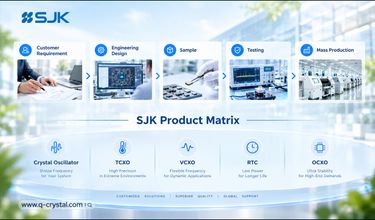
Crystal Oscillators: Working Principles, Types, Applications, and How to Choose the Right One
Introduction
In today's fast-paced electronics industry, accurate timing and frequency stability are essential for the reliable operation of electronic devices. From smartphones and automotive systems to industrial automation and wireless communication equipment, crystal oscillators play a critical role in ensuring precise timing and synchronization.
But what exactly is a crystal oscillator, how does it work, and what should engineers consider when selecting one for their applications?
In this article, we explore the fundamentals of crystal oscillators, their different types, key specifications, and major applications across modern industries.
1. What Is a Crystal Oscillator?
A crystal oscillator is an electronic circuit that uses a quartz crystal as a frequency-determining component to generate a stable and precise electrical signal.
Quartz crystals have a unique property known as the piezoelectric effect. When an electrical voltage is applied, the crystal mechanically vibrates at a specific frequency. Conversely, mechanical vibration generates an electrical signal.
Due to their excellent frequency stability, high quality factor (Q), and relatively low cost, quartz crystal oscillators are widely used as timing references in electronic systems.
2. How Does a Crystal Oscillator Work?
The operating principle of a crystal oscillator is based on the mechanical resonance of a quartz crystal.
When the oscillator circuit applies an electrical signal to the crystal, the crystal begins vibrating at its natural resonant frequency. The electronic circuit maintains these vibrations and produces a continuous output signal.
The frequency of oscillation is determined by several factors, including:
- Quartz crystal dimensions and cutting angle
- Resonant frequency
- Load capacitance
- Temperature
- Circuit design and operating conditions
The high Q factor of quartz resonators helps minimize frequency fluctuations, making crystal oscillators suitable for applications requiring accurate and stable clock signals.
3. Common Types of Crystal Oscillators
Different applications require different levels of frequency accuracy, stability, and environmental performance.
Here are some commonly used types:
3.1 XO – Standard Crystal Oscillator
Standard crystal oscillators provide a stable clock signal for general electronic applications.
Typical applications include:
- Microcontrollers
- Consumer electronics
- Communication devices
- Digital circuits
3.2 TCXO – Temperature Compensated Crystal Oscillator
A TCXO incorporates a temperature compensation circuit to minimize frequency variations caused by changes in ambient temperature.
TCXOs are commonly used in:
- GPS and navigation systems
- Wireless communication equipment
- Telecommunications
- Portable electronic devices
3.3 VCXO – Voltage Controlled Crystal Oscillator
A VCXO allows its output frequency to be adjusted within a specified range by changing the control voltage.
Typical applications include:
- Clock synchronization
- Network communication
- Digital video systems
- Frequency synthesis
3.4 OCXO – Oven Controlled Crystal Oscillator
An OCXO maintains the quartz crystal at a controlled temperature using an internal heating system.
This helps achieve excellent frequency stability, particularly in environments with significant temperature variations.
Typical applications include:
- Telecommunications infrastructure
- Aerospace and defense equipment
- Precision instrumentation
- Frequency reference systems
4. Key Specifications to Consider When Selecting a Crystal Oscillator
Selecting the right crystal oscillator is essential for ensuring the performance and reliability of an electronic product.
Engineers should pay attention to the following parameters:
Frequency
The operating frequency must match the requirements of the target application. Common frequencies include 8 MHz, 16 MHz, 25 MHz, 40 MHz, and 50 MHz, although many other frequencies are available.
Frequency Stability
Frequency stability indicates how much the output frequency can vary under different operating conditions. It is commonly expressed in parts per million (ppm).
Operating Temperature Range
The oscillator must operate reliably within the expected environmental temperature range.
Supply Voltage
The operating voltage must be compatible with the electronic circuit.
Output Type
Common output configurations include CMOS, LVDS, and other differential output formats, depending on application requirements.
Package Size
Compact packages are increasingly important in portable electronics, IoT devices, and space-constrained PCB designs.
5. Major Applications of Crystal Oscillators
Crystal oscillators are essential components in many industries.
Consumer Electronics
Smartphones, tablets, laptops, digital cameras, and wearable devices rely on accurate clock signals for system synchronization and data processing.
Automotive Electronics
Automotive applications include ADAS, infotainment systems, navigation modules, vehicle communication networks, and electronic control units (ECUs).
Industrial Automation
Crystal oscillators provide timing references for industrial controllers, sensors, measurement instruments, and communication interfaces.
Telecommunications
Stable frequency references are essential for wireless communication systems, networking equipment, base stations, and data transmission.
IoT and Smart Devices
With the rapid growth of connected devices, crystal oscillators support reliable timing and synchronization in wireless modules, smart meters, sensors, and other IoT applications.
6. Crystal Oscillator vs. Crystal Resonator: What Is the Difference?
Although these terms are sometimes used interchangeably, they refer to different components.
A quartz crystal resonator is a passive component that requires an external oscillator circuit to generate a clock signal.
A crystal oscillator, on the other hand, typically integrates a quartz resonator and its associated oscillation circuitry into one package.
In general:
- Crystal resonators offer flexibility in circuit design and can be cost-effective.
- Crystal oscillators provide a ready-to-use clock signal and simplify system integration.
The choice depends on the application, circuit architecture, performance requirements, and overall design cost.
7. Future Trends in Crystal Oscillator Technology
As electronic devices become smaller, faster, and more interconnected, crystal oscillator technology continues to evolve.
Several important trends are shaping the industry:
- Miniaturization: Smaller packages support increasingly compact electronic designs.
- Higher Frequency Stability: Advanced compensation and control technologies improve timing accuracy.
- Low Power Consumption: Energy-efficient oscillators are increasingly important for battery-powered and IoT devices.
- Automotive Reliability: Demand for components with extended temperature ranges and high reliability continues to grow.
- High-Speed Communication: Advanced timing solutions support increasingly demanding data transmission and synchronization requirements.
Conclusion
Crystal oscillators are fundamental components in modern electronic systems, providing the accurate and stable frequency references required for reliable operation.
Understanding their working principles, types, and key specifications helps engineers select the most suitable timing solution for their applications.
Whether designing consumer electronics, automotive systems, industrial equipment, or communication devices, choosing the right crystal oscillator can make a significant difference in overall system performance and reliability.
Looking for a reliable crystal oscillator supplier?
Working with an experienced manufacturer can help you identify the right frequency solution, optimize component performance, and meet your specific application requirements.
Contact our team to learn more about our crystal oscillator products and customized timing solutions.

Contact
Official Chinese website:www.q-crystal.com.cn
Satisfaction quality, Just-in-time service, and Key-cost offering
©2026 SJK All Rights Reserved.