



How Does a Quartz Crystal Oscillator Work?
A quartz crystal oscillator generates a stable electrical signal by using the natural resonance of quartz inside an electronic feedback circuit. The quartz crystal provides a highly selective resonant frequency, while the oscillator circuit supplies the gain and feedback needed to keep the signal oscillating.
A simple way to picture the process is:
Electrical signal → Quartz resonance → Feedback → Sustained oscillation → Stable frequency output
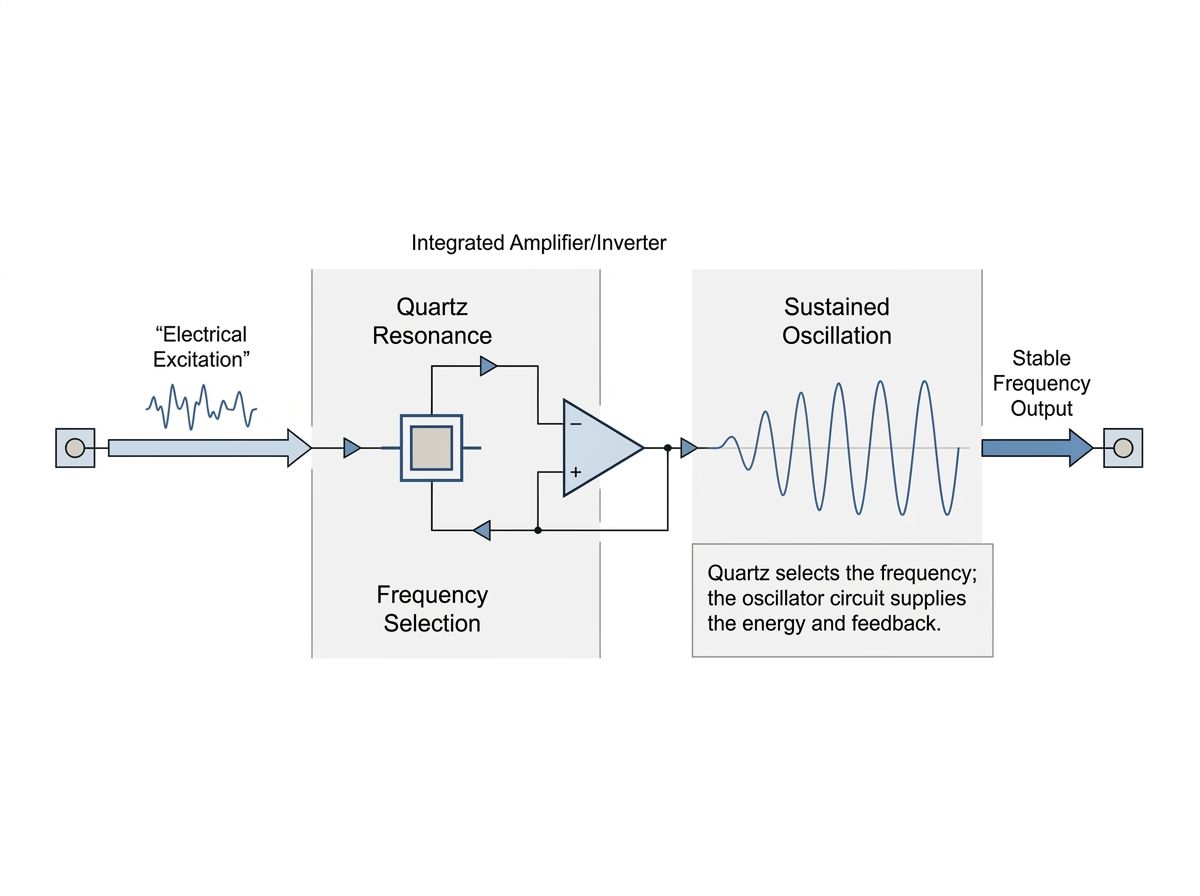
The important point is that a quartz crystal and a quartz crystal oscillator are not the same thing. The crystal acts as the resonator that strongly favors a particular frequency. The oscillator circuit uses that resonance to generate and maintain a continuous electrical signal.
How Does a Quartz Crystal Produce Its Resonant Frequency?
The starting point is the piezoelectric effect of quartz.
When an electrical voltage is applied across a quartz crystal, the crystal undergoes a very small mechanical deformation. Conversely, mechanical movement in the crystal produces an electrical response. This interaction allows electrical energy and mechanical vibration to transfer back and forth within the crystal.
The crystal is manufactured with a specific shape, cut, and vibration mode so that it has predictable resonant characteristics. When an electrical signal is applied near its resonant frequency, the crystal responds much more strongly than it does at frequencies farther away.
This makes quartz particularly useful as a frequency-selective resonator.
It is similar to pushing a swing. A swing naturally responds most strongly when it is pushed at the right rhythm. The swing does not create the energy by itself; rather, its physical characteristics determine the rhythm at which it responds most efficiently.
A quartz crystal behaves in a much more precise way. Its mechanical properties determine a narrow frequency region in which it resonates strongly, allowing an oscillator circuit to use that resonance as a frequency reference.
What Do Series and Parallel Resonance Mean?
A quartz crystal can be represented by an electrical equivalent circuit that includes its motional resistance, inductance, and capacitance, together with its shunt capacitance. This model helps engineers understand how the crystal's impedance changes around resonance.
At its series resonant frequency, the crystal's motional inductance and capacitance resonate, giving the crystal relatively low impedance. At a slightly higher frequency, the crystal can exhibit parallel resonance, where the effective impedance is much higher.
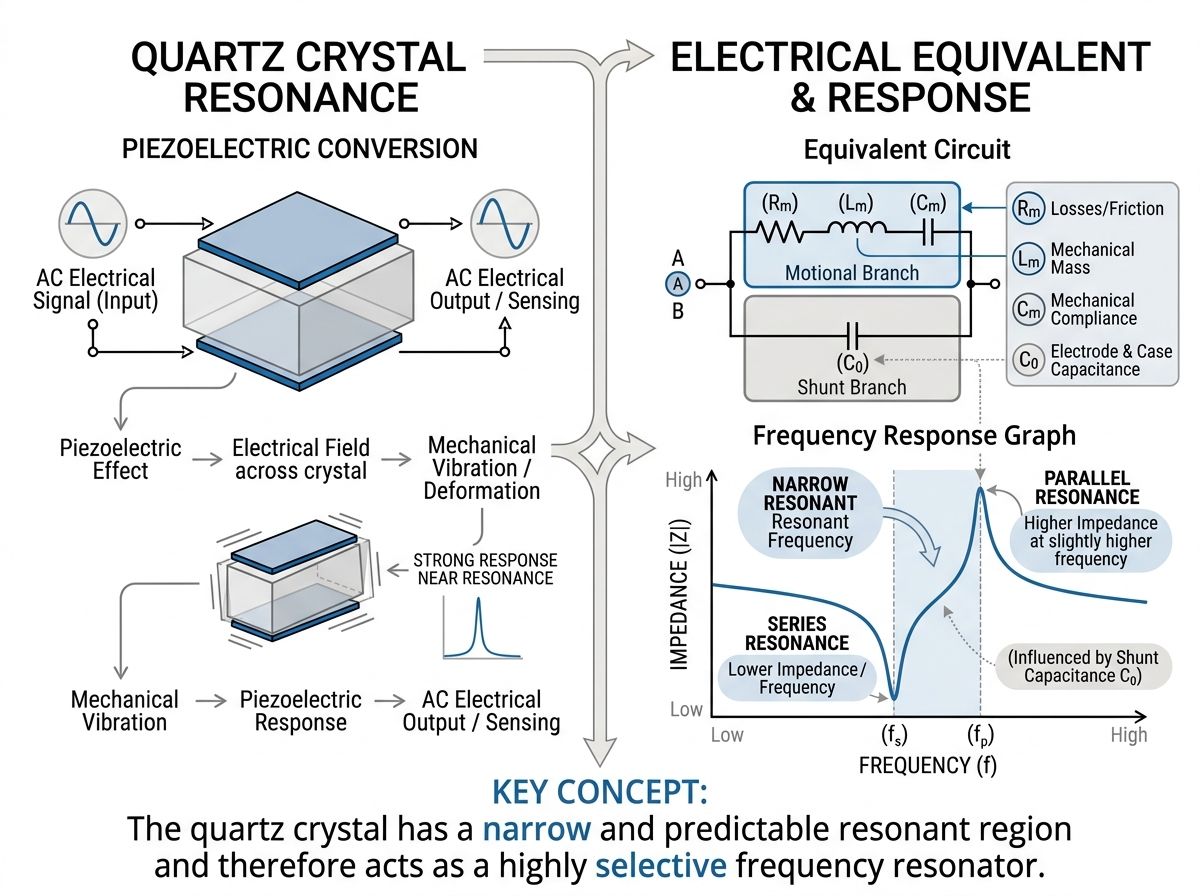
The difference matters because a crystal may be specified for operation in a particular resonance condition, and the oscillator circuit determines how that condition is used.
For most users, the key takeaway is simple: the crystal has a very narrow and predictable resonance, and the oscillator circuit is designed to operate around that resonance.
How Does a Quartz Crystal Become an Oscillator?
A crystal provides resonance, but it cannot sustain continuous oscillation by itself. Energy is lost from the system, so an electronic circuit must continually replace that energy.
This is where the oscillator circuit comes in.
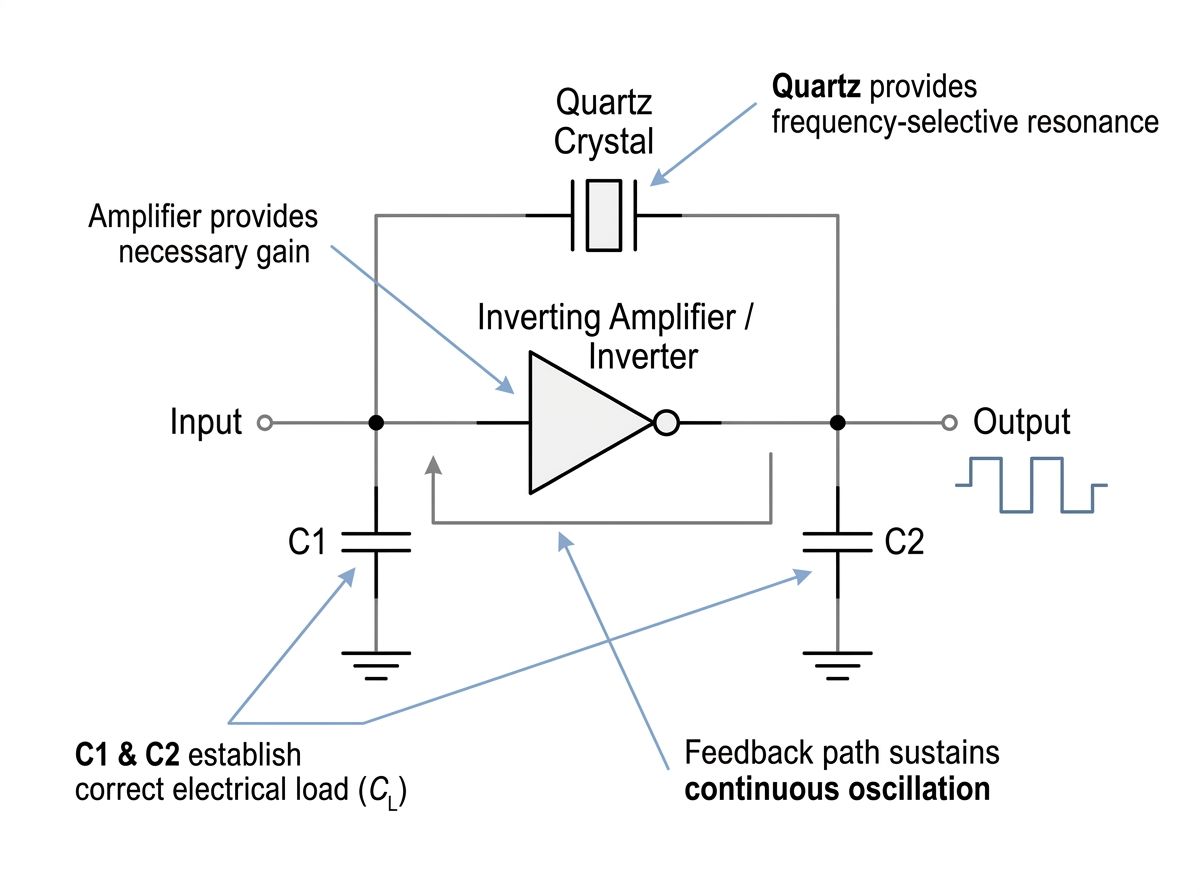
A basic crystal oscillator combines the quartz crystal with an amplifier and a feedback path. The amplifier provides gain, while the feedback network sends part of the output signal back through the circuit. When the feedback has the appropriate gain and phase relationship, the signal reinforces itself from one cycle to the next.
The crystal plays a particularly important role because it strongly favors frequencies around its resonance. Instead of allowing the feedback loop to reinforce a wide range of frequencies equally, the crystal makes the desired frequency much more selective.
This is the fundamental working principle of a quartz crystal oscillator:
The quartz crystal selects the frequency; the electronic circuit supplies the energy needed to sustain the oscillation.
This distinction is also important when looking at practical circuits. A standalone quartz crystal is a resonating component. A complete crystal oscillator includes the active circuitry needed to turn that resonance into a usable electrical output.
For example, some microcontrollers have an oscillator circuit built into the IC. An external quartz crystal can then serve as the frequency-selective resonator, while the IC provides the amplification and feedback.
What Happens When a Quartz Crystal Oscillator Starts Up?
A crystal oscillator does not need an external signal already oscillating at exactly its target frequency.
When power is applied, a real electronic circuit contains small transient signals and noise. If the oscillator circuit has enough loop gain and the appropriate phase relationship around the intended operating frequency, these small signals are reinforced by the feedback loop.
The quartz crystal favors the frequency range around its resonance, so that component of the signal receives stronger reinforcement. The oscillation gradually builds until the circuit reaches its normal operating condition.
In simplified terms:
Power is applied → small signals appear → the feedback loop reinforces suitable signals → the crystal favors its resonant frequency → oscillation builds → stable output is established.
This is why startup is a property of the complete oscillator system, not just the crystal. The crystal's characteristics, load conditions, amplifier, feedback network, and drive level all contribute to whether oscillation starts reliably and how quickly it reaches a stable state.
How Does a Pierce Crystal Oscillator Work?
One common way to build a crystal oscillator is the Pierce oscillator.
A typical Pierce configuration uses an inverting amplifier, a quartz crystal, and capacitive elements that form part of the feedback network. The amplifier provides the gain needed to sustain oscillation, while the crystal provides the frequency-selective resonance.
The two capacitors are also important. Together with the crystal and the rest of the oscillator circuit, they determine the effective load seen by the crystal. Their values can therefore affect the actual operating frequency and the startup behavior.
The basic relationship can be pictured as:
Inverting amplifier ↔ Quartz crystal + capacitive network
When the circuit operates at the appropriate frequency, the signal returning through the feedback path has the conditions required to reinforce the oscillation.
Pierce oscillators are widely used in digital timing circuits because the configuration can be implemented with relatively few components and works well with inverter-based circuits. Many microcontroller clock circuits use a similar principle, with part of the oscillator circuitry integrated into the IC.
However, the exact requirements vary between devices. When selecting a crystal for a specific IC, the manufacturer's recommended crystal characteristics, load capacitance, drive level, and oscillator specifications should be followed rather than relying on a generic Pierce circuit alone.
Why Is a Quartz Crystal Oscillator So Stable?
One major reason quartz oscillators can provide high frequency stability is the high Q factor of the quartz resonator.
Q factor describes how sharply a resonator responds around its resonant frequency. A high-Q resonator has a narrow resonance and relatively low energy loss. Quartz can therefore provide much stronger frequency selectivity than many conventional electronic resonators.
That narrow resonance helps the feedback circuit maintain a consistent operating frequency.
However, high Q is only part of the story. The actual frequency stability of a quartz oscillator also depends on the crystal cut, temperature, aging, load conditions, drive level, and the design of the oscillator circuit.
Temperature is particularly important because the resonant characteristics of quartz change with temperature. The crystal's cut is therefore selected according to the required frequency-temperature performance. AT-cut quartz, for example, is widely used because it provides useful temperature characteristics for many timing applications.
When greater stability is required, oscillator designs can incorporate additional techniques. A TCXO, or temperature-compensated crystal oscillator, electronically compensates for temperature-related frequency changes. An OCXO, or oven-controlled crystal oscillator, maintains the crystal at a controlled temperature to achieve much tighter stability.
So the stability of a quartz crystal oscillator comes from the combination of a high-quality quartz resonator and a carefully designed oscillator system.
What Determines the Frequency of a Quartz Crystal Oscillator?
The frequency of a quartz crystal is closely related to its physical design.
The crystal's dimensions, cut orientation, and vibration mode determine its mechanical resonance. The electrode structure and the way the crystal is incorporated into the oscillator also affect its electrical behavior.
This is why a crystal designed for 10 MHz, for example, cannot simply be treated as a generic piece of quartz that happens to produce 10 MHz. Its physical structure has been engineered to provide the required resonant characteristics.
The oscillator circuit also matters. For crystals designed for parallel-resonant operation, the load capacitance presented by the circuit can shift the actual operating frequency. This is why the crystal's specified load capacitance needs to be compatible with the oscillator design.
Some crystals can also operate in overtone modes, allowing higher operating frequencies than the fundamental mode. The appropriate mode depends on the crystal's design and the oscillator circuit.
In other words, the final operating frequency is determined by the interaction between the physical characteristics of the quartz resonator and the electrical conditions of the oscillator circuit.
How Do You Choose the Right Quartz Crystal Oscillator?
Once the working principle is clear, selecting a crystal oscillator becomes a matter of matching its characteristics to the timing requirements of the application.
Start with the required frequency and frequency stability. A processor, communication system, industrial controller, or automotive system may require a specific frequency and a defined level of allowable frequency variation over temperature and time.
The operating environment is equally important. If the oscillator will experience a wide temperature range, its frequency-temperature characteristics should be evaluated rather than looking only at its nominal frequency.
For a crystal used with an external oscillator circuit, electrical compatibility also needs to be checked. Load capacitance, drive level, and the oscillator circuit itself can affect how the crystal operates. For a complete crystal oscillator, parameters such as supply voltage, output format, jitter, and phase noise may become more relevant.
The right choice therefore depends on the complete timing requirement of the system, not simply on finding a crystal with the correct nominal frequency.
Quartz Crystal Oscillator Working Principle in Simple Terms
The working principle can be reduced to one idea:
Quartz provides the resonance. The oscillator circuit provides the energy and feedback.
The quartz crystal has a highly selective resonant frequency because of its piezoelectric and mechanical properties. When incorporated into an electronic feedback circuit, it causes the circuit to favor that frequency. The amplifier then continuously supplies the energy lost during each cycle, allowing the oscillation to continue.
That is what turns a quartz resonator into a practical frequency source.
Once this relationship is understood, terms such as crystal resonator, crystal oscillator, Pierce oscillator, frequency stability, load capacitance, and TCXO become easier to understand because they describe different parts or implementations of the same basic frequency-control principle.
Looking for a Quartz Crystal Oscillator for Your Application?
The right oscillator depends on more than nominal frequency. Frequency stability, temperature performance, output requirements, package, load conditions, and the needs of the target application all need to be considered together.
SJK Crystal develops quartz crystal and oscillator solutions for applications where stable and reliable frequency control is required. If you are selecting a crystal oscillator for a specific electronic system, contact our technical team to discuss your frequency, stability, package, and application requirements.

Contact
Official Chinese website:www.q-crystal.com.cn
Satisfaction quality, Just-in-time service, and Key-cost offering
©2026 SJK All Rights Reserved.