



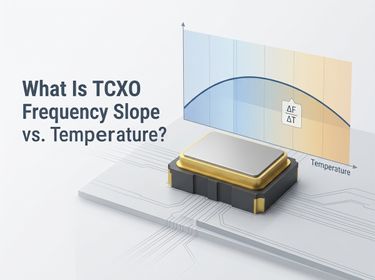
What Is Frequency Slope vs. Temperature in a TCXO?
Frequency slope vs. temperature describes how quickly a TCXO's output frequency changes as temperature changes. It is commonly expressed in ppm/°C or ppb/°C and represented as ΔF/ΔT. Frequency slope is closely related to temperature stability, but the two specifications describe different aspects of oscillator performance.
What Is Frequency Slope vs. Temperature in a TCXO?
A TCXO (Temperature Compensated Crystal Oscillator) is designed to reduce the frequency variation that naturally occurs when a quartz resonator experiences temperature changes. Even after compensation, some residual frequency variation remains.
Frequency slope describes the rate of this frequency change with temperature.
For a defined temperature interval, frequency slope can be expressed as:
Frequency slope = ΔF / ΔT
where:
ΔF is the change in frequency deviation
ΔT is the corresponding temperature change
ppm/°C means parts per million per degree Celsius
ppb/°C means parts per billion per degree Celsius
For example, if frequency deviation changes by 0.5 ppm over a 10°C interval, the average change over that interval would be:
0.5 ppm ÷ 10°C = 0.05 ppm/°C = 50 ppb/°C
This is an illustrative calculation, not a product specification.
A smaller frequency slope generally indicates lower frequency sensitivity to temperature over the specified interval. However, the exact way a manufacturer defines and measures frequency slope matters. Some specifications evaluate slope over particular temperature intervals or report the maximum absolute slope observed across the operating range.
A TCXO's frequency-versus-temperature characteristic is also not necessarily linear. As a result, the slope can vary at different temperatures rather than remaining constant across the entire operating range.
Frequency Slope vs. Frequency Stability: What's the Difference?
Frequency slope and frequency stability are related, but they answer different questions:
| Specification | What it describes | Typical unit |
|---|---|---|
| Frequency slope | How rapidly frequency changes as temperature changes | ppm/°C or ppb/°C |
| Frequency stability vs. temperature | How much frequency can deviate under specified temperature conditions | ppm or ppb |
| Operating temperature range | The temperature range over which a specification applies | °C |
In simple terms:
Frequency slope tells you how quickly frequency changes with temperature; frequency stability tells you how much frequency can deviate under the specified conditions.
Frequency slope
Frequency slope is particularly useful when evaluating how an oscillator responds to relatively small temperature changes around an operating point. For example, if the ambient temperature changes by a few degrees, slope indicates the oscillator's temperature sensitivity within the relevant interval. Frequency slope is expressed as ΔF/ΔT, typically in ppm/°C or ppb/°C.
Frequency stability over temperature
Temperature stability instead describes the allowed frequency deviation under a specified temperature condition or range. The exact definition can depend on the oscillator specification and the conditions stated in the datasheet. Frequency stability may also be discussed alongside other sources of frequency variation, such as supply voltage, load and aging.
Why can't you simply divide stability by temperature range?
Suppose a hypothetical TCXO has a specified temperature stability of ±1 ppm over a 100°C range. It may seem reasonable to calculate:
1 ppm ÷ 100°C = 0.01 ppm/°C
and treat the result as the frequency slope.
That approach is not generally valid.
The frequency-versus-temperature characteristic of a TCXO is not necessarily linear. Microchip's TCXO technical documentation specifically notes that a total frequency-stability error over a temperature range cannot simply be divided by that range to produce a per-degree gradient. The shape of the frequency-temperature curve, including changes in crystal characteristics, needs to be considered.
Therefore, temperature stability and frequency slope should be interpreted as separate specifications rather than converted directly from one to the other.
Why Does Temperature Affect TCXO Frequency?
Quartz resonators have an inherent frequency-versus-temperature characteristic. Changes in temperature alter the resonator's behavior, causing its frequency to shift. The resulting temperature characteristic depends on the resonator design and crystal properties.
A TCXO uses temperature-compensation circuitry to reduce this variation. Depending on the design, a compensation system can sense temperature and adjust the oscillator's electrical characteristics to counteract the expected frequency change. Microchip describes TCXOs as using a programmable ASIC or thermistor network to adjust a varactor and compensate for the crystal's frequency-versus-temperature curve.
The simplified process is:
Quartz temperature characteristic
→ Temperature sensing and compensation
→ Frequency correction
→ Reduced temperature-related frequency variation
The objective is not to make the resonator completely unaffected by temperature. Instead, compensation reduces the residual frequency variation so that the oscillator can meet its specified temperature-performance requirements.
How Do You Read a TCXO Frequency-vs-Temperature Curve?
A frequency-versus-temperature curve provides a visual way to understand how an oscillator responds to temperature.
Check the axes
The X-axis normally represents temperature, typically in °C.
The Y-axis may represent frequency deviation or frequency error relative to a nominal or reference frequency. Depending on the datasheet, the value may be expressed in ppm or ppb. The exact definition should always be checked in the graph or specification notes.
Look at the slope of the curve
For a defined temperature interval:
Slope = ΔF / ΔT
A relatively flat section of the curve indicates less frequency change per degree over that interval, while a steeper section indicates greater temperature sensitivity.
A simplified temperature-frequency curve might look like this:
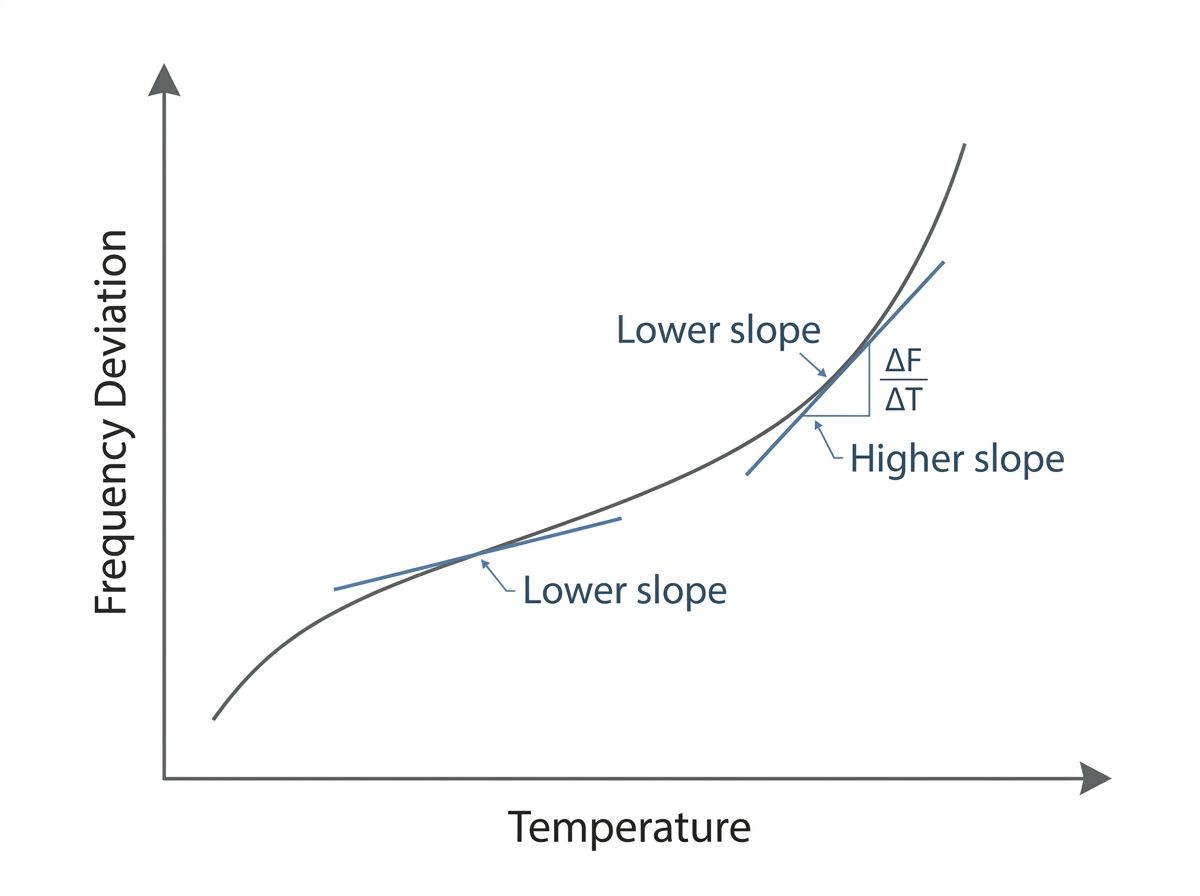
The important point is that the curve may be nonlinear. Its slope can therefore change across the temperature range. When evaluating a datasheet, the relevant question is not simply whether the entire curve looks "flat," but how the manufacturer defines the slope and over which temperature interval it is specified. Because the frequency-versus-temperature curve may be nonlinear, the slope can vary across the operating range. A reported value may therefore be specified as the maximum absolute slope within a defined temperature range.
When Does Frequency Slope Matter in TCXO Selection?
Frequency slope becomes particularly important when an application is sensitive to temperature-induced frequency changes. The required level of temperature performance depends on the system's frequency or timing budget rather than on the slope value alone.
GNSS and navigation
GNSS-related systems can use stable frequency references for RF and timing functions. Temperature-induced frequency variation can therefore contribute to the frequency-error budget of the reference source.
RF and wireless systems
A TCXO may provide the frequency reference for RF or frequency-generation circuits. Changes in reference frequency caused by temperature can affect systems that require tight frequency control.
Telecom synchronization
In synchronization applications, temperature-related frequency changes can contribute to timing error. Frequency slope can be particularly important in precision timing and synchronization applications, including systems based on IEEE 1588, where temperature-related frequency variation can contribute to timing error.
Precision timing
Applications with tight timing requirements may need to consider both overall temperature stability and the rate of frequency change caused by temperature variations.
Other specifications to check
Frequency slope should be evaluated together with other relevant TCXO specifications, including:
Frequency stability vs. temperature
Operating temperature range
Initial frequency tolerance
Aging
Supply voltage sensitivity
Load sensitivity
Phase noise
Jitter
Output type
Frequency range
These parameters describe different sources or aspects of oscillator performance. For example, aging concerns frequency change over time, while supply and load sensitivity address changes caused by electrical operating conditions. The complete frequency requirement therefore needs to be considered rather than relying on one specification alone.
SJK TCXO Solutions
SJK provides TCXO and VC-TCXO solutions for applications requiring controlled frequency performance across changing operating conditions. Its current portfolio covers multiple frequency ranges, package configurations and output options, with product specifications provided in the corresponding datasheets.
When selecting an SJK TCXO, engineers should evaluate the product-specific frequency stability, operating temperature range, output characteristics, frequency range and other electrical specifications against the requirements of the application. Product-level performance should always be confirmed using the applicable SJK datasheet.
SJK also applies a structured quality and reliability approach to its manufacturing process. According to its official Quality & Reliability information, the company implements total quality management, defined test procedures and requirements, advanced and comprehensive test instruments, strict inspection standards and accurate operating requirements. Its manufacturing facilities have also introduced a ±3σ strategy to strengthen product quality, support stable product function and maintain consistent quality.
This combination of product-level specifications and controlled manufacturing processes provides the basis for evaluating SJK frequency-control components against specific application requirements.
Frequently Asked Questions
What is frequency slope in a TCXO?
Frequency slope describes how rapidly a TCXO's output frequency changes as temperature changes. It is commonly expressed in ppm/°C or ppb/°C and represented as ΔF/ΔT over a defined temperature interval.
Is frequency slope the same as frequency stability?
No. Frequency slope describes the rate of frequency change with temperature, while frequency stability describes the amount of frequency deviation specified under defined operating conditions. They should not be treated as interchangeable specifications.
What does ppm/°C mean for a TCXO?
ppm/°C expresses the change in frequency deviation associated with a 1°C temperature change under the specified definition and conditions. For example, 0.01 ppm/°C is equivalent to 10 ppb/°C.
Does a lower frequency slope mean a better TCXO?
Not by itself. A lower frequency slope indicates lower frequency sensitivity to temperature over the relevant interval, but overall TCXO performance also depends on temperature stability, operating range, aging, supply and load sensitivity, phase noise, jitter and the requirements of the application.
Key Takeaway
Frequency slope and frequency stability describe different aspects of TCXO temperature performance. Frequency slope indicates how rapidly frequency changes as temperature changes, while frequency stability describes the permitted frequency deviation under specified conditions. Because the frequency-versus-temperature characteristic can be nonlinear, frequency slope should be interpreted according to its defined temperature interval and measurement conditions rather than calculated from overall stability alone.
For TCXO selection, the most useful approach is to consider frequency slope together with temperature stability, operating range and the application's overall frequency or timing requirements.

Contact
Official Chinese website:www.q-crystal.com.cn
Satisfaction quality, Just-in-time service, and Key-cost offering
©2026 SJK All Rights Reserved.