



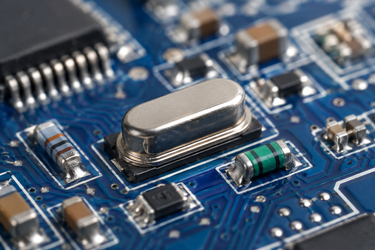
Optimizing Crystal Oscillator Circuits: The Role of Capacitors and Resistors
In modern electronic design, even a well-selected crystal oscillator can fail to deliver stable performance if the surrounding circuit is poorly optimized. A carefully designed crystal oscillator circuit depends not only on the oscillator itself, but also on supporting components such as capacitors and resistors. These seemingly simple passive devices directly affect frequency stability, startup reliability, noise suppression, and long-term circuit behavior.
Whether you're designing IoT sensors, automotive ECUs, industrial controllers, or high-speed communication devices, understanding how capacitors and resistors interact with quartz crystals is essential for achieving reliable timing performance. So how exactly do these components influence oscillator behavior, and what design mistakes should engineers avoid?
The Synergy Between Crystal Oscillators and Capacitors
Capacitors play a critical role in determining how a crystal oscillator circuit performs. In most oscillator topologies, especially Pierce oscillator configurations commonly used in microcontrollers and embedded systems, capacitors help establish the proper load capacitance required by the quartz crystal.
The crystal manufacturer typically specifies a target load capacitance (CL), which defines the capacitance value at which the crystal achieves its nominal frequency. If the actual circuit capacitance deviates from this value, frequency drift and instability may occur.
Understanding Load Capacitance in Oscillator Design
The effective load capacitance seen by the crystal is usually determined by two external capacitors and stray PCB capacitance.
Improper capacitor selection can cause several issues:
- Frequency offset from the target specification
- Poor oscillator startup
- Increased phase noise
- Reduced frequency stability under temperature variation
For example, in IoT and RTC applications using 32.768kHz crystals, even a small mismatch in load capacitance may lead to noticeable clock drift over time.
Selecting Capacitors for Different Applications
Different applications require different capacitor optimization strategies:
| Application | Typical Design Priority | Capacitor Consideration |
|---|---|---|
| IoT devices | Low power consumption | Lower drive level and optimized CL |
| Automotive electronics | High reliability | Temperature-stable capacitors |
| 5G communication | Low phase noise | Precision matching and low ESR |
| Industrial control | Long-term stability | Tight tolerance MLCC capacitors |
In high-frequency oscillator circuits, PCB layout becomes equally important. Excessive trace length or poor grounding introduces parasitic capacitance that changes the intended quartz crystal matching conditions.
A practical recommendation is to place capacitors as close to the crystal pins as possible while minimizing routing loops. Engineers should also account for MCU internal capacitance when calculating the total load capacitance.
Another important consideration is capacitor dielectric material. C0G/NP0 capacitors are often preferred in precision oscillator circuits because they provide minimal temperature drift compared to X7R or Y5V materials.
The Function of Resistors in Oscillator Circuits
While capacitors determine much of the frequency behavior, resistors are equally important for maintaining oscillator reliability and protecting sensitive components inside the crystal oscillator circuit.
Resistors influence:
- Oscillator startup characteristics
- Signal amplitude control
- Loop gain stabilization
- Overdrive protection
- Noise suppression
Depending on the oscillator architecture, both series resistor and parallel resistor configurations may be used.
In many practical designs, resistor optimization is overlooked during early prototyping stages. However, poorly selected resistor values can lead to intermittent startup failures or excessive crystal drive levels that shorten component lifespan.
Techniques for Stabilizing Circuits Using Resistors
Circuit stabilization is one of the primary functions of resistors in oscillator networks. By carefully controlling current flow and loop gain, resistors help maintain steady oscillation conditions under varying environmental and electrical conditions.
Why Circuit Stabilization Matters
Without proper stabilization:
- Oscillation amplitude may become excessive
- Noise sensitivity increases
- Startup becomes inconsistent
- Frequency jitter worsens
A resistor placed strategically within the feedback loop helps prevent the oscillator from operating too aggressively. This becomes especially important in automotive and industrial environments where voltage fluctuations and EMI are common.
In low-power wearable devices, stabilization resistors can also reduce unnecessary energy consumption by controlling oscillator drive strength.
Common Stabilization Practices
Experienced hardware engineers often apply the following techniques:
- Use damping resistors to suppress unwanted harmonics
- Add feedback resistors to improve bias stability
- Reduce excessive crystal drive levels in high-gain MCUs
- Optimize resistor values during environmental testing
Because every PCB layout and MCU architecture behaves differently, resistor tuning is frequently validated through real-world testing rather than theoretical calculation alone.
Protecting Oscillators with Series Resistors
A series resistor is commonly inserted between the oscillator output and the crystal network. Its primary purpose is to limit drive current and protect the quartz crystal from excessive energy.
This becomes particularly important when using modern high-speed MCUs with strong internal transconductance amplifiers.
Benefits of a Series Resistor
Properly selected series resistors provide several advantages:
- Prevent crystal overdrive
- Reduce electromagnetic interference (EMI)
- Improve waveform quality
- Lower long-term aging effects
- Minimize harmonic distortion
In some high-frequency applications, engineers intentionally increase the series resistor value slightly to reduce signal overshoot and ringing.
However, excessive resistance may also create problems. If the resistor value is too high:
- Oscillator startup time increases
- Oscillation may fail at low temperatures
- Signal amplitude becomes insufficient
For this reason, resistor optimization should always be validated under worst-case operating conditions.
Typical Design Considerations
When implementing a series resistor, designers should evaluate:
Crystal ESR characteristics
MCU oscillator gain
Operating temperature range
Startup margin
Power supply stability
There is no universal resistor value suitable for every design. Instead, proper component matching and empirical testing are essential for robust quartz crystal matching.
Enhancing Startup Performance via Parallel Resistors
A parallel resistor, often connected across the inverter input and output in Pierce oscillator circuits, helps establish the correct DC bias point for oscillation startup.
Without sufficient biasing, some oscillator circuits may struggle to start consistently, especially during cold starts or low-voltage operation.
How Parallel Resistors Improve Oscillator Startup
The main function of a parallel resistor is to:
- Provide DC feedback
- Stabilize inverter bias voltage
- Maintain amplifier operation within the linear region
This significantly improves oscillator startup reliability.
In battery-powered systems such as smart wearables and remote IoT devices, startup consistency is especially critical because unstable oscillation can lead to communication failure or timing errors.
Startup Optimization Techniques
To improve oscillator startup performance, engineers often:
- Select appropriate resistor values based on MCU recommendations
- Minimize PCB contamination and leakage paths
- Reduce stray capacitance near the crystal
- Validate startup time across voltage and temperature ranges
In many cases, startup issues blamed on the crystal itself are actually caused by improper resistor or capacitor configuration inside the crystal oscillator circuit.
PCB Layout Considerations for Better Oscillator Performance
Even with properly selected capacitors and resistors, poor PCB layout can severely degrade oscillator performance.
To improve overall circuit stability:
- Keep crystal traces short and symmetrical
- Avoid routing high-speed digital lines near the oscillator
- Use solid ground planes
- Isolate oscillator circuits from switching power supplies
- Minimize via usage around crystal components
Parasitic effects from PCB layout often become more noticeable in high-frequency communication equipment and precision timing systems.
For automotive-grade designs, engineers should additionally consider vibration resistance and thermal stress when selecting component placement and soldering structures.
Conclusion
Capacitors and resistors are far more than supporting components in a crystal oscillator circuit. They directly influence load capacitance, oscillator startup, signal integrity, and long-term circuit stabilization. Proper component selection and PCB optimization help engineers achieve better frequency accuracy, lower noise, and more reliable system performance.
As a professional frequency control component manufacturer with over 36 years of industry experience, SJK Crystal provides high-quality quartz crystals, crystal oscillators, TCXOs, VCXOs, and customized frequency control solutions for automotive, IoT, industrial, and communication applications. If you're looking for reliable quartz crystal matching support or advanced oscillator solutions, SJK's engineering team can help optimize your next design.
FAQ
What is load capacitance in a crystal oscillator circuit?
Load capacitance refers to the effective capacitance connected to the quartz crystal. It determines the crystal's operating frequency accuracy and directly affects frequency stability.
Why is a series resistor used in oscillator circuits?
A series resistor helps limit crystal drive current, reduce EMI, and protect the oscillator from overdrive conditions that may shorten crystal lifespan.
How does a parallel resistor improve oscillator startup?
A parallel resistor provides DC bias feedback that keeps the inverter operating in its linear region, helping the oscillator startup process become more stable and reliable.
What causes oscillator startup failure?
Common causes include incorrect load capacitance, excessive series resistance, poor PCB layout, high crystal ESR, or insufficient loop gain.
Why is quartz crystal matching important?
Proper quartz crystal matching ensures stable oscillation, accurate frequency output, and reliable long-term circuit performance across different environmental conditions.
Which capacitors are best for crystal oscillator circuits?
C0G/NP0 ceramic capacitors are typically preferred because they offer excellent temperature stability and low capacitance variation.

Contact
Official Chinese website:www.q-crystal.com.cn
Satisfaction quality, Just-in-time service, and Key-cost offering
©2026 SJK All Rights Reserved.