



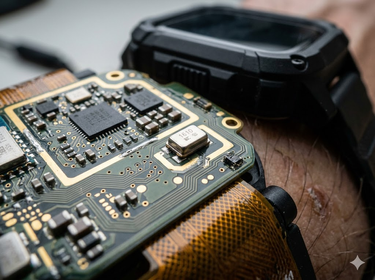
Why 32.768kHz Crystals Remain Essential for Wearable Electronics
Designing hardware for modern miniaturized devices imposes brutal constraints on engineering teams. Board real estate is measured in millimeters, and the power budget is strictly limited to microamps. At the foundation of this power management architecture sits a highly specific component: the 32.768kHz crystal. Providing the fundamental timing baseline for the system’s Real-Time Clock, this specific frequency remains absolutely non-negotiable for system wake-up protocols, peripheral synchronization, and overall state machine management. Despite the rapid advancement of silicon integration and alternative timing solutions, the passive 32.768kHz quartz resonator continues to dominate the market. This article explores the physical mechanics that make this component irreplaceable, the engineering hurdles of extreme miniaturization, and the integration strategies required for reliable low-power hardware design.
The Engineering Behind the Tuning Fork Crystal
The ubiquity of the 32,768 Hz frequency is not an accident; it is the result of elegant binary mathematics. When this specific frequency is routed through a standard 15-stage binary divider circuit inside a microcontroller, it yields a precise 1.000 Hz clock signal. This exact 1-second pulse is the heartbeat of all real-time tracking operations.
To achieve this low frequency without creating a massive, physically unviable piece of quartz, manufacturers utilize a Tuning Fork Crystal design. Unlike high-frequency AT-cut crystals that vibrate in a thickness-shear mode, tuning fork resonators operate in a flexural mode. The two tines of the quartz fork vibrate side-to-side, which allows for a much lower resonant frequency in a physically compact form factor.
| Parameter | 32.768kHz Tuning Fork | High-Frequency (MHz) AT-Cut |
| Vibration Mode | Flexural (Bending) | Thickness-Shear |
| Typical ESR | 50 kΩ to 90 kΩ | 20 Ω to 100 Ω |
| Drive Level | 0.1 µW to 1.0 µW | 10 µW to 300 µW |
| Temperature Curve | Parabolic (Turnover ~25°C) | Cubic (S-Curve) |
| Primary Application | RTC, Sleep Mode Timing | MCU Core Clock, RF Carrier |
The Role of RTC in Battery Life Optimization
When evaluating power consumption in battery-operated systems, engineers must focus heavily on the sleep-state current draw. An application processor running at full speed will consume milliamps of current, draining a standard coin cell or small lithium-polymer battery in a matter of hours. To achieve months or years of operational longevity, the microcontroller must spend over 99% of its life in a deep sleep state, shutting down its core, its high-speed MHz clocks, and its radio transceivers. During this dormant period, the Real-Time Clock circuit remains the only active subsystem.
The integration of an optimized timing baseline directly dictates the power efficiency of the entire device. Relying on an inaccurate timing source forces the microcontroller to wake up prematurely or stay awake longer than necessary to ensure data synchronization, wasting highly valuable energy. By implementing a highly accurate timing loop, the system executes operations with zero wasted active time.
- Precise Sleep/Wake Duty Cycles:A highly accurate clock allows the system to calculate the exact millisecond required to wake up, execute a sensor reading, and return to sleep. Drift in this timing means widening the reception windows, which drastically increases the time the system stays in its high-power active mode.
- Bluetooth Low Energy (BLE) Synchronization:In BLE applications, devices must synchronize their connection events at specific intervals. Tight timing tolerances prevent connection drops and eliminate the need for extended, power-hungry scanning phases to re-establish a link.
- Data Logging Time-Stamps:Health monitors and fitness trackers require accurate timestamps for biometric data. Processing this data locally with a reliable clock prevents the system from having to constantly query a paired smartphone for network time.
Passive Resonators vs. Active Low power oscillator
Engineers frequently debate the merits of using a passive quartz resonator versus an active low power oscillator module. While an active oscillator integrates the quartz blank and the oscillator circuit into a single package—simplifying layout and guaranteeing start-up—it typically draws more continuous current (often in the low microamps). In contrast, pairing a passive resonator with the microcontroller's internal low-power oscillator circuitry can drive the sleep current down into the nanoamp range (typically 100nA to 300nA). For extreme power-constrained environments, the passive component remains the superior architectural choice.
Solving Large Frequency Deviation in Small Packages
The relentless push toward miniaturization introduces severe mechanical and electrical complexities. As the physical dimensions of the quartz blank are reduced to fit into microscopic surface-mount device (SMD) packages, the Equivalent Series Resistance (ESR) of the component naturally rises. This is a critical physical limitation: shorter, narrower quartz tines offer less mass and less electromechanical coupling efficiency. A high ESR requires the amplifier circuit inside the microcontroller to provide a higher transconductance to sustain oscillation. If the ESR exceeds the driving capability of the internal circuit, the system will fail to start up entirely. Furthermore, shrinking the mechanical dimensions makes the blank exponentially more susceptible to manufacturing tolerances, packaging stresses, and external temperature gradients, all of which manifest as critical timing errors in the field.
To counteract these physical realities and prevent frequency deviation, modern manufacturing relies on highly controlled photolithography processes rather than traditional mechanical tuning. Photolithographic etching allows for microscopic precision in the geometry of the quartz tines, ensuring perfect symmetry and suppressing unwanted parasitic vibration modes. This chemical etching process is vital for maintaining a tight initial parts-per-million (ppm) tolerance before the component is sealed. Additionally, the quartz blank is housed in a vacuum-sealed ceramic cavity. This vacuum environment eliminates air damping, which drastically lowers the ESR and protects the resonator from moisture and environmental contaminants. Managing the parabolic temperature coefficient—where the oscillation slows down symmetrically at extreme heat or cold—requires precise tuning of the turnover temperature during manufacturing, ensuring the device operates flawlessly within the standard 25°C baseline of human body temperature.
SJK’s Ultra-Small 1210 & 1610 MHz Solutions
The evolution of printed circuit board density demands footprint reduction without a proportional loss in hardware performance. SJK’s Ultra-Small 1210 & 1610 MHz Solutions represent a highly engineered portfolio designed explicitly to bridge the gap between microscopic physical dimensions and strict electrical tolerances. These 1.2x1.0 mm and 1.6x1.2 mm SMD packages are designed for high-density layouts where every fraction of a millimeter dictates product feasibility.
By employing advanced vacuum sealing and photolithographic tuning, these micro-packages support both the low-power kHz requirements for RTCs and the MHz requirements for peripheral communications on the same dense board space. The design ensures that engineers do not have to compromise on power consumption just to meet physical size limits.
- Optimized Motional Capacitance:Designed to pair seamlessly with the low transconductance amplifiers found in modern BLE Systems-on-Chip (SoCs), ensuring guaranteed start-up even at ultra-low drive levels (often below 0.1 µW).
- Minimized ESR in Micro-Footprints:Despite the 1210 and 1610 footprint scale, the internal geometry is maximized to keep ESR safely below the critical thresholds of standard microcontrollers.
- Robust Environmental Integrity:The ceramic seam-sealed packaging withstands severe mechanical shock, reflow soldering stresses, and temperature fluctuations, maintaining timing stability in rugged field conditions.
Hardware Layouts in Wearable electronics
Achieving the rated ppm accuracy of a timing component requires strict adherence to PCB layout rules. Parasitic capacitance from sloppy routing will inevitably pull the frequency off-target.
- Keep Traces Short:Route the connections between the quartz component and the microcontroller oscillator pins as short and symmetrical as possible to minimize stray capacitance and inductance.
- Implement Guard Rings:Encircle the timing circuit traces with a grounded guard ring connected to the internal ground plane. This prevents high-frequency switching noise from adjacent digital lines from coupling into the sensitive analog clock traces.
- Avoid Routing Beneath the Component:Do not route high-speed digital signals or RF traces through the PCB layers directly underneath the timing circuit. The electromagnetic interference (EMI) will inject noise into the low-power sine wave, causing jitter or complete oscillator stall.
FAQ
Why use a 32.768kHz crystal instead of an internal RC oscillator?
Internal Resistor-Capacitor (RC) oscillators integrated into microcontrollers are highly susceptible to temperature and voltage variations, often drifting by 1% to 5%. A dedicated 32.768kHz crystal offers physical resonance, providing accuracies of ±20 ppm, which is mandatory for maintaining a reliable Real-Time Clock over long periods.
What causes frequency deviation over time in a wearable device?
Frequency deviation is primarily driven by three factors: the parabolic temperature coefficient of the tuning fork quartz (drifting when moving away from 25°C), incorrect load capacitance matching on the PCB causing the frequency to "pull," and long-term mechanical aging of the quartz blank itself.
How do I choose the right load capacitance (CL) for an RTC Crystal?
The load capacitance must match the specifications of the microcontroller's internal oscillator design. Wearable electronics typically require extremely low CL values, such as 6pF or 7pF, to minimize the current required to drive the oscillator loop. Selecting a mismatched CL will permanently offset your timing baseline.
Can a low power oscillator module replace a passive resonator?
Yes, an active low power oscillator (like an SPXO) can replace a passive component. It simplifies board layout and guarantees start-up because the amplifier is built-in. However, for devices demanding absolute maximum battery longevity, the passive approach combined with an optimized MCU deep-sleep state usually yields the lowest possible microamp draw.
How does the tuning fork crystal handle physical shock in sports trackers?
Modern surface-mount tuning fork resonators are secured inside their ceramic housing using specialized conductive adhesives and are vacuum-sealed. While quartz is inherently brittle, these advanced packaging techniques allow the component to withstand the standard drop tests and mechanical shocks expected in consumer fitness applications.

Contact
Official Chinese website:www.q-crystal.com.cn
Satisfaction quality, Just-in-time service, and Key-cost offering
©2026 SJK All Rights Reserved.