



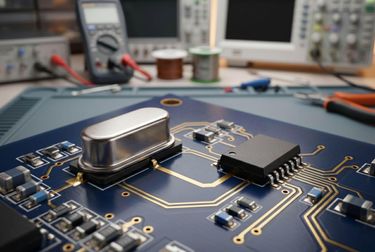
Real-Time Clock (RTC) ICs vs. Crystal Oscillators: A Comprehensive Comparison
Accurate timing is something most electronic systems quietly depend on. Whether it's a wearable device tracking sleep cycles, an automotive ECU synchronizing communication, or an IoT sensor waking up at scheduled intervals, timing components sit at the center of reliable operation. When engineers evaluate RTC vs crystal oscillator solutions, the decision often affects power consumption, system precision, PCB complexity, and even product lifespan.
At first glance, a real-time clock chip and a crystal oscillator may seem interchangeable because both deal with timing signals. In reality, they serve different purposes and often work together inside the same design. So how do these components differ, and when should you choose one over the other?
Fundamentals of Crystal Oscillators
Crystal oscillators are among the most widely used timing components in modern electronics. They generate stable clock signals by utilizing the mechanical resonance properties of quartz crystals.
Basic Introduction to Crystal Oscillators
A crystal oscillator typically combines:
- A quartz crystal resonator
- An amplifier circuit
- Feedback components
- Frequency stabilization circuitry
When voltage is applied, the quartz crystal vibrates at a highly precise frequency due to the piezoelectric effect. These oscillations are converted into electrical signals that provide timing references for processors, communication modules, and digital systems.
One of the most common frequencies used in low-power applications is the 32.768kHz crystal, especially in battery-powered devices and RTC systems.
Operating Principles of Crystal Oscillators
The operating principle of a crystal oscillator is based on resonance. Quartz material naturally vibrates at a predictable frequency when electrically stimulated. The oscillator circuit amplifies and sustains this vibration to create a stable periodic signal.
Different oscillator structures are designed for different performance requirements:
- SPXO for standard timing
- TCXO for temperature compensation
- VCXO for voltage-controlled frequency adjustment
- OCXO for ultra-high stability environments
In high-frequency communication systems such as 5G infrastructure, oscillator stability directly impacts signal integrity and synchronization performance.
Core Functions of Crystal Oscillators
Crystal oscillators are primarily used to:
- Generate system clock signals
- Synchronize communication interfaces
- Maintain data transmission timing
- Control processor operation
- Support wireless communication modules
Because of their high precision and low phase noise, quartz oscillators remain essential in telecommunications, industrial automation, and automotive electronics.
Benefits and Limitations
Crystal oscillators offer several major advantages:
- Excellent frequency stability
- Low phase noise
- Long operational lifespan
- High precision across temperature ranges
- Mature and cost-effective manufacturing
However, they also have limitations:
- External circuitry may be required
- Startup time can vary
- Sensitivity to mechanical shock in some environments
- Higher-end oscillators may increase system cost
For portable electronics, engineers must balance stability and power consumption carefully when selecting oscillator architectures.
Understanding Real-Time Clock (RTC) Chips
While crystal oscillators generate frequency signals, a real-time clock chip is designed to maintain actual calendar time and date information, even when the main system power is turned off.
Basics of RTC ICs
An RTC IC is a low-power integrated circuit that continuously tracks:
- Seconds
- Minutes
- Hours
- Days
- Months
- Years
Most RTC IC designs rely on an external 32.768kHz crystal as their timing reference because this frequency divides efficiently into one-second intervals using binary counters.
This relationship explains why RTC vs crystal oscillator comparisons can sometimes be confusing. An RTC IC usually depends on a crystal oscillator source to function accurately.
How RTC Chips Operate
RTC chips use ultra-low-power counters and registers to keep time continuously. Backup batteries or supercapacitors allow the RTC system to continue operating during main power interruptions.
A typical RTC system includes:
- RTC controller IC
- Quartz crystal resonator
- Backup power source
- Communication interface (I2C or SPI)
Compared with standard clock-generation oscillators, RTC ICs prioritize:
- Extremely low current consumption
- Long-term timekeeping
- Calendar management
- Alarm and wake-up functions
These features make RTC chips highly suitable for smart meters, wearable devices, industrial monitoring equipment, and IoT edge devices.
Key Advantages of RTC ICs
The main benefits of RTC IC solutions include:
- Continuous timekeeping during power loss
- Ultra-low standby power
- Built-in alarm and timer functions
- Simplified system scheduling
- Reduced MCU workload
In many embedded systems, the RTC IC acts as a power management assistant by waking the processor only when necessary, significantly extending battery life.
However, RTC accuracy still depends heavily on proper crystal selection and PCB design. Poor matching between the RTC IC and the external 32.768kHz crystal can introduce time drift and startup instability.
Interdependence and Key Differences
Although they are often discussed separately, crystal oscillators and RTC ICs are closely connected in practical hardware design.
An RTC IC generally requires a crystal reference source to maintain accurate timing, while a crystal oscillator alone cannot track calendar time without additional logic and counters.
This functional distinction is the foundation of RTC vs crystal oscillator comparisons.
The Relationship Between RTC ICs and Crystal Oscillators
In many low-power systems:
- The quartz crystal provides frequency accuracy
- The RTC IC converts oscillation into usable timekeeping data
This combination allows systems to maintain accurate timestamps while minimizing energy consumption.
For example:
- Smartwatches use RTC ICs for sleep scheduling
- IoT sensors use RTC alarms for periodic data transmission
- Automotive systems rely on RTC synchronization during power transitions
Without stable quartz timing references, RTC accuracy degrades significantly over time.
Core Distinctions Between the Two
The following comparison highlights the main quartz oscillator differences between RTC ICs and crystal oscillators:
| Feature | Crystal Oscillator | RTC IC |
|---|---|---|
| Main Function | Generate clock signals | Maintain calendar time |
| Output | Frequency signal | Time/date data |
| Power Consumption | Moderate to low | Ultra-low |
| Requires External Crystal | Sometimes integrated | Usually yes |
| Typical Frequency | MHz range or 32.768kHz | Commonly 32.768kHz |
| Application Focus | Clock generation | Timekeeping and scheduling |
Although their functions differ, both are critical timing components in modern electronics.
Choosing the Right Solution
The choice between an RTC IC and a crystal oscillator depends on system requirements.
A crystal oscillator is usually preferred when:
- High-frequency clock generation is required
- Communication synchronization is critical
- Low phase noise is essential
- System timing precision is the main priority
An RTC IC is preferred when:
- Continuous timekeeping is necessary
- Low-power sleep scheduling is needed
- Battery backup operation is required
- Calendar management functions are important
In many practical designs, engineers integrate both components together for optimal performance.
Design Considerations for Better Timing Accuracy
Selecting the correct timing components involves more than simply choosing frequency values.
Engineers should also evaluate:
- Frequency tolerance
- Temperature stability
- Load capacitance
- PCB parasitic effects
- Startup characteristics
- Aging performance
Even a high-quality real-time clock chip can suffer poor timing accuracy if paired with an improperly matched crystal.
Similarly, poor PCB layout can introduce noise and leakage currents that reduce oscillator stability.
To improve timing performance:
- Place crystals close to the RTC IC
- Minimize PCB trace length
- Use grounded shielding when necessary
- Select low-ESR quartz crystals
- Validate startup across temperature ranges
Careful quartz crystal matching remains one of the most important factors in long-term timing reliability.
Conclusion
Understanding RTC vs crystal oscillator technologies helps engineers build more stable, power-efficient, and reliable electronic systems. While crystal oscillators provide accurate frequency generation, RTC ICs manage continuous timekeeping and scheduling functions. In most modern embedded applications, these components work together rather than compete against each other.
With over 36 years of expertise in frequency control solutions, SJK Crystal offers high-quality quartz crystals, RTC timing solutions, TCXOs, VCXOs, and customized oscillator products for IoT, automotive, industrial, and communication applications. If you're searching for reliable timing components with long-term stability, SJK's engineering team is ready to support your next project.
FAQ
What is the difference between an RTC IC and a crystal oscillator?
An RTC IC maintains calendar time and scheduling functions, while a crystal oscillator generates stable frequency signals for electronic systems.
Why is a 32.768kHz crystal commonly used in RTC designs?
A 32.768kHz crystal divides evenly into one-second intervals using binary counters, making it ideal for low-power real-time clock chip applications.
Can an RTC IC work without a crystal oscillator?
Most RTC ICs require an external quartz crystal to provide accurate timing references and stable clock signals.
Which consumes less power: RTC IC or crystal oscillator?
An RTC IC is typically optimized for ultra-low standby power consumption, especially in battery-powered devices.
What factors affect RTC timing accuracy?
Timing accuracy depends on crystal quality, load capacitance, PCB layout, temperature stability, and quartz crystal matching.
Are RTC ICs used in IoT devices?
Yes. RTC ICs are widely used in IoT systems for sleep scheduling, timestamp recording, and low-power wake-up control.

Contact
Official Chinese website:www.q-crystal.com.cn
Satisfaction quality, Just-in-time service, and Key-cost offering
©2026 SJK All Rights Reserved.