



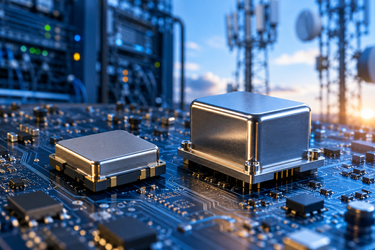
TCXO vs. OCXO: Which Oscillator is Best for Your Telecommunications Design?
When designing telecommunications equipment, timing accuracy is not simply a performance metric—it often determines whether a system can maintain synchronization, reduce signal interference, and deliver reliable data transmission. As network technologies become more sophisticated, engineers frequently face the question of TCXO vs OCXO when selecting a high stability oscillator.
Both technologies are widely used in communication systems, GPS receivers, industrial automation, and precision timing applications. However, they differ significantly in temperature performance, power consumption, cost, and application suitability. Understanding these differences can help designers choose the most effective oscillator solution for their projects. So, when should you choose a TCXO, and when does an OCXO become the better investment?
Understanding Temperature Compensation in Oscillators
Frequency stability is one of the most critical parameters in oscillator performance. Environmental temperature changes can cause a quartz crystal's resonant frequency to drift, potentially impacting communication accuracy and synchronization.
Why Temperature Affects Crystal Oscillators
Quartz crystals naturally exhibit frequency variation as temperature changes. Even small fluctuations can become problematic in applications such as:
- Cellular base stations
- GPS navigation systems
- Satellite communication equipment
- Precision industrial control systems
- Timing synchronization networks
Without compensation, frequency drift can accumulate over time and reduce overall system reliability.
What Is a Temperature Compensated Crystal Oscillator?
A temperature compensated crystal oscillator (TCXO) uses compensation circuitry to automatically correct frequency variations caused by temperature changes.
A TCXO typically contains:
- Quartz crystal resonator
- Temperature sensing circuit
- Compensation network
- Oscillator circuitry
The compensation mechanism continuously adjusts operating parameters to maintain stable output across a specified temperature range.
Compared with standard crystal oscillators, TCXOs provide:
- Better frequency accuracy
- Improved environmental stability
- Lower phase noise in many applications
- Compact form factors suitable for portable devices
This makes TCXOs a preferred choice for modern wireless communication and positioning systems.
How OCXOs Achieve Superior Stability
Unlike TCXOs, OCXOs use a completely different approach.
An Oven-Controlled Crystal Oscillator (OCXO) places the crystal inside a temperature-controlled chamber. The oscillator continuously maintains the crystal at a fixed operating temperature, regardless of external environmental conditions.
This design significantly minimizes frequency drift and allows OCXOs to achieve exceptional stability levels that are difficult for other oscillator technologies to match.
TCXO vs. OCXO: Key Differences in Stability, Power, and Cost
The TCXO vs OCXO debate often comes down to balancing performance requirements with practical design constraints.
Although both technologies aim to improve frequency stability, they are optimized for different use cases.
Frequency Stability Comparison
The most obvious difference lies in stability performance.
| Parameter | TCXO | OCXO |
|---|---|---|
| Frequency Stability | Good | Excellent |
| Temperature Compensation | Electronic correction | Oven-controlled environment |
| Aging Performance | Moderate | Superior |
| Phase Noise | Low | Very Low |
| Warm-Up Time | Immediate | Several minutes |
| Cost | Lower | Higher |
OCXOs typically provide stability in the parts-per-billion (ppb) range, while TCXOs generally operate within parts-per-million (ppm) specifications.
For telecommunications infrastructure requiring precise synchronization, this difference can be significant.
Power Consumption Differences
Power consumption often becomes a deciding factor during component selection.
TCXOs are designed for low-power operation and are commonly found in:
- Smartphones
- IoT sensors
- Wearable electronics
- Portable communication devices
OCXOs consume substantially more power because energy is required to maintain the oven chamber at a constant temperature.
As a result, OCXOs are more commonly used in:
- Network timing equipment
- Telecom base stations
- Precision instrumentation
- Military communication systems
For battery-powered products, TCXOs are generally the more practical solution.
Cost Considerations
Budget constraints are another important factor.
TCXOs offer:
- Lower manufacturing costs
- Smaller package sizes
- Simpler integration
OCXOs offer:
- Maximum stability
- Better aging performance
- Enhanced long-term reliability
However, these benefits come with increased component cost and larger physical dimensions.
For many commercial telecommunications products, the additional performance of an OCXO may not justify the higher investment unless ultra-precise synchronization is required.
Why 5G and GPS Modules Rely Heavily on TCXOs
As wireless communication technologies continue to evolve, TCXOs have become indispensable in both GPS timing solutions and 5G communication systems.
The Importance of Frequency Stability in GPS Systems
GPS receivers depend on extremely accurate timing references to calculate location data.
Even minor frequency deviations can introduce:
- Positioning errors
- Signal acquisition delays
- Reduced navigation accuracy
A temperature compensated crystal oscillator helps ensure stable operation across varying environmental conditions, making it an ideal choice for mobile navigation devices, drones, vehicle tracking systems, and wearable products.
Why TCXOs Are Essential for 5G Networks
A modern 5G crystal oscillator must maintain frequency accuracy under demanding operating conditions.
5G communication systems require:
- Precise carrier synchronization
- Low phase noise
- Fast startup
- Compact package dimensions
- Low power consumption
TCXOs provide an excellent balance between performance and efficiency, which explains their widespread adoption in:
- Small-cell base stations
- Mobile terminals
- Wireless modules
- IoT communication gateways
While OCXOs are frequently deployed in core network infrastructure and synchronization equipment, TCXOs dominate edge devices where size and power efficiency are equally important.
In many telecommunications architectures, both technologies coexist, serving different levels of the network hierarchy.
How to Select the Right High-Stability Oscillator for Your Project
Choosing the right high stability oscillator requires evaluating multiple technical and commercial factors.
Key Selection Criteria
Before selecting an oscillator, engineers should assess:
- Frequency accuracy requirements
- Operating temperature range
- Available power budget
- PCB space limitations
- Long-term aging specifications
- System synchronization requirements
A portable GPS tracker and a telecom synchronization server will naturally have very different oscillator requirements.
When to Choose a TCXO
A TCXO is often the best choice when:
- Low power consumption is critical
- Compact size is required
- Cost efficiency matters
- Fast startup is necessary
- GPS timing solutions are involved
These characteristics make TCXOs highly suitable for mass-market communication products.
When to Choose an OCXO
An OCXO becomes the preferred option when:
- Maximum frequency stability is required
- Long-term synchronization is critical
- Environmental conditions are highly variable
- System downtime is unacceptable
- Precision timing infrastructure is involved
Examples include telecom timing servers, network synchronization equipment, and advanced laboratory instruments.
Working with a Reliable TCXO Supplier
Oscillator performance depends not only on technology selection but also on manufacturing quality.
A qualified TCXO supplier should offer:
- Consistent production quality
- Tight frequency tolerances
- Comprehensive testing procedures
- Industry certifications
- Engineering support
Selecting a trusted supplier can significantly reduce design risks and improve long-term product reliability.
Conclusion
The choice between TCXO vs OCXO ultimately depends on your application's performance targets, power constraints, and budget considerations. TCXOs provide an excellent balance of accuracy, efficiency, and affordability for GPS and 5G applications, while OCXOs deliver the highest level of stability for mission-critical telecommunications infrastructure.
With more than 36 years of experience in frequency control technologies, SJK offers a comprehensive portfolio of TCXOs, OCXOs, quartz crystals, and customized timing solutions for telecommunications, industrial automation, automotive electronics, and IoT applications. If you're looking for a reliable high stability oscillator or an experienced TCXO supplier, SJK can help you identify the ideal solution for your next project.
FAQ
What is the main difference between TCXO and OCXO?
The primary difference in TCXO vs OCXO designs is how they manage temperature effects. TCXOs use electronic compensation, while OCXOs maintain a constant crystal temperature using an oven-controlled chamber.
Is a temperature compensated crystal oscillator suitable for GPS applications?
Yes. A temperature compensated crystal oscillator is widely used in GPS timing solutions because it provides excellent frequency stability while maintaining low power consumption.
Why are TCXOs commonly used in 5G devices?
A 5G crystal oscillator must provide stable frequency performance, low phase noise, and efficient power usage. TCXOs meet these requirements while remaining compact and cost-effective.
Do OCXOs provide better stability than TCXOs?
Yes. OCXOs generally offer significantly higher frequency stability and better aging performance, making them ideal for telecom synchronization and precision timing applications.
How do I choose a reliable TCXO supplier?
Look for a TCXO supplier with strong manufacturing capabilities, quality certifications, engineering support, and proven experience in frequency control technologies.
Can TCXOs replace OCXOs in telecommunications systems?
In many edge-network and mobile applications, TCXOs can provide sufficient performance. However, core synchronization systems often still require OCXOs for maximum timing accuracy.

Contact
Official Chinese website:www.q-crystal.com.cn
Satisfaction quality, Just-in-time service, and Key-cost offering
©2026 SJK All Rights Reserved.