



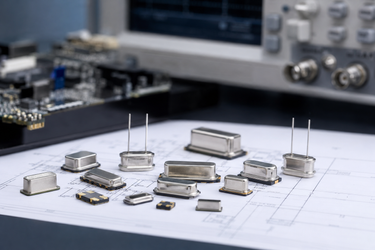
Custom Frequency Crystal Oscillators: How to Specify Requirements for Manufacturing
Specifying a custom frequency crystal oscillator for manufacturing requires defining key parameters such as frequency, tolerance, stability, load capacitance, ESR, operating temperature, package size, and production requirements. Providing complete specifications at the beginning helps manufacturers deliver a reliable custom crystal oscillator while reducing engineering revisions and lead times.
Modern electronic systems increasingly demand timing accuracy that cannot always be achieved with off-the-shelf components. When a standard frequency does not meet application requirements, a custom frequency crystal oscillator provides a practical solution by allowing engineers to define electrical and mechanical specifications tailored to their design.
However, achieving the desired performance requires more than simply requesting a different frequency. Manufacturers need detailed technical requirements to ensure the custom frequency oscillator performs reliably throughout production and its operating lifetime. A properly specified custom frequency oscillator also reduces production risk during mass manufacturing.
Whether designing industrial controllers, automotive electronics, medical devices, telecommunications equipment, or IoT products, understanding how to specify a custom quartz crystal or non-standard frequency oscillator helps reduce design iterations, shorten development cycles, and improve long-term reliability.
When Standard Frequencies (e.g., 32.768kHz, 24MHz) Aren't Enough
Standard crystal frequencies such as 32.768kHz, 24MHz, 16MHz, and 40MHz cover many consumer and embedded applications. These frequencies are widely available because they support common microcontrollers, real-time clocks, USB interfaces, and communication protocols.
However, many specialized applications require a custom crystal oscillator because standard values cannot satisfy unique system requirements.
Common examples include:
- Proprietary wireless communication protocols
- Specialized RF equipment
- Precision industrial automation systems
- Aerospace and defense electronics
- Medical monitoring devices
- High-speed networking equipment
- Custom FPGA or ASIC designs
In these situations, engineers often need a non-standard frequency oscillator that matches an exact clock architecture or synchronization requirement.
| Standard Crystal | Custom Frequency Crystal Oscillator |
|---|---|
| Fixed standard frequencies | User-defined frequencies |
| Standard package options | Customized package sizes |
| General-purpose applications | Application-specific designs |
| Short lead time | Depends on customization level |
| Suitable for common electronics | Ideal for specialized industrial systems |
For example, a communication module may require a frequency specifically optimized for signal processing, while an industrial controller may need a customized frequency to synchronize multiple processing units with minimal timing error.
Rather than redesigning the circuit around an available frequency, selecting a custom frequency oscillator often provides a more efficient and reliable engineering solution.
In addition to unique operating frequencies, many OEMs require customized package dimensions, tighter frequency tolerance, wider operating temperature ranges, or lower phase noise than standard products can provide. These requirements are particularly common in industrial automation, satellite communications, automotive electronics, and high-speed networking equipment, where clock accuracy directly influences overall system performance.
Another important consideration is product differentiation. As electronic products become more specialized, manufacturers increasingly adopt bespoke timing solutions that optimize performance while reducing interference, improving power efficiency, or meeting industry certification requirements.
Key Parameters to Define When Ordering Custom Crystals
When ordering a custom frequency crystal oscillator, manufacturers typically require seven key specifications: operating frequency, frequency tolerance, frequency stability, load capacitance, ESR, package size, and operating temperature range. Providing these specifications early helps reduce engineering revisions, shorten lead times, and improve manufacturing consistency.
Choosing a custom quartz crystal involves much more than specifying the desired frequency. Manufacturers require several electrical and mechanical parameters before production begins.
Providing complete specifications at the beginning helps avoid engineering revisions and manufacturing delays.
Frequency Tolerance and Stability
Frequency tolerance describes how closely the crystal matches its nominal frequency at room temperature.
It is typically expressed in parts per million (ppm).
Common tolerance values include:
| Application | Typical Tolerance |
|---|---|
| Consumer Electronics | ±30 ppm |
| Industrial Equipment | ±20 ppm |
| Telecommunications | ±10 ppm |
| Precision Instruments | ±5 ppm or better |
Frequency stability measures how much the frequency changes across the operating temperature range.
According to JEDEC and common industry specifications, crystal frequency tolerance is generally measured in parts per million (ppm), with high-performance timing devices often requiring stability better than ±10 ppm across their specified operating temperature range.
For example, a crystal with ±10 ppm tolerance and ±20 ppm stability may experience a total variation of approximately ±30 ppm during operation.
Engineers selecting a custom crystal oscillator should carefully evaluate:
- Operating temperature range
- Required clock accuracy
- Long-term aging
- Environmental conditions
- Regulatory requirements
Higher precision usually requires tighter manufacturing control, which may increase production complexity and cost.
For critical applications such as telecommunications infrastructure or navigation equipment, selecting appropriate stability specifications is often more important than choosing the nominal frequency itself.
Load Capacitance and Equivalent Series Resistance (ESR)
Load capacitance (CL) is one of the most important parameters affecting oscillation frequency.
The oscillator circuit and the crystal must be designed to operate together.
Common load capacitance values include:
- 6 pF
- 8 pF
- 9 pF
- 10 pF
- 12 pF
- 18 pF
- 20 pF
Using the wrong load capacitance can shift the operating frequency away from its intended value.
Equivalent Series Resistance (ESR) represents the internal resistance of the crystal during oscillation.
Lower ESR generally provides:
- Easier oscillator startup
- Improved signal quality
- Lower power consumption
- Better compatibility with low-drive circuits
However, acceptable ESR depends on:
- Crystal frequency
- Package size
- Oscillator circuit design
- Drive level
Excessive ESR may prevent the oscillator circuit from starting correctly or reduce frequency stability under certain operating conditions. Therefore, designers should always verify that the crystal's ESR specification matches the oscillator IC manufacturer's recommendations.
When requesting a custom quartz crystal, engineers should provide both load capacitance and maximum allowable ESR to ensure compatibility with the target hardware.
Manufacturers may also recommend optimized values based on application experience and simulation results.
Typical Lead Times and MOQ for Custom Timing Solutions
One common misconception is that every custom crystal oscillator requires extremely long production cycles.
In reality, lead time depends on several factors, including design complexity, tooling requirements, qualification testing, and production volume.
Typical development stages include:
- Engineering specification review
- Feasibility evaluation
- Sample production
- Electrical validation
- Customer approval
- Mass production
For designs based on existing platforms with only frequency adjustments, sampling can often be completed within a relatively short period.
Completely new mechanical packages or highly specialized specifications generally require additional engineering verification and qualification testing before volume manufacturing begins.
Minimum order quantity (MOQ) also varies.
Factors influencing MOQ include:
- Package type
- Frequency uniqueness
- Material sourcing
- Manufacturing process
- Testing requirements
Some bespoke timing solutions can be produced with relatively low MOQs during product development, while high-volume production programs benefit from larger manufacturing batches that improve production efficiency.
Early communication between the customer and supplier helps define realistic schedules and avoids unnecessary delays.
Providing complete technical documentation—including application schematics, environmental requirements, and target certifications—can significantly shorten the quotation and engineering review process.
Partnering with Q-Crystal for Bespoke Designs
Choosing an experienced manufacturing partner is equally important as defining the correct specifications. Beyond production capability, manufacturers should provide engineering consultation, design verification, prototype support, and quality validation throughout product development.
Beyond producing the component itself, an experienced supplier can assist customers in refining specifications, identifying potential design issues, and recommending suitable materials or package options before production begins.
Q-Crystal provides a range of custom crystal oscillator and custom quartz crystal solutions designed to support applications across industrial automation, telecommunications, automotive electronics, medical devices, consumer electronics, and IoT systems. Rather than offering only catalog products, the company supports customized frequency development, package selection, electrical parameter optimization, and application-specific engineering services according to customer requirements.
Its engineering process typically includes specification review, prototype evaluation, sample verification, and quality testing before mass production. This collaborative approach helps customers confirm that the selected non-standard frequency oscillator aligns with the electrical characteristics and environmental conditions of the final product.
In addition to customized frequencies, customers may specify parameters such as load capacitance, frequency tolerance, operating temperature range, ESR, aging performance, package dimensions, and reliability requirements. These capabilities make bespoke timing solutions suitable for projects where standard components cannot fully satisfy design objectives.
As electronic systems continue to demand higher precision, lower power consumption, and greater reliability, collaboration between design engineers and crystal manufacturers becomes increasingly important during the early stages of product development.
Conclusion
Selecting the right custom crystal oscillator is not simply about requesting a unique frequency. Accurate specification of frequency tolerance, stability, load capacitance, ESR, operating conditions, and production requirements allows manufacturers to produce a custom frequency oscillator that delivers consistent performance throughout the product lifecycle. Careful planning also helps reduce redesign costs, improve manufacturing efficiency, and accelerate time to market.
For projects requiring custom quartz crystal, non-standard frequency oscillator, or other bespoke timing solutions, working with an experienced manufacturer can simplify the development process. Q-Crystal combines engineering support with manufacturing capabilities to help customers develop timing solutions that match their specific application requirements while maintaining reliable product quality.
FAQ
What is a custom frequency crystal oscillator?
A custom frequency crystal oscillator is a timing component manufactured to meet application-specific requirements that cannot be fulfilled by standard frequency products. In addition to a unique operating frequency, customers can often specify parameters such as frequency tolerance, stability, load capacitance, ESR, package size, and operating temperature range to optimize performance for their electronic system.
When should I choose a custom crystal oscillator instead of a standard one?
A custom crystal oscillator is recommended when standard frequencies, package sizes, or electrical specifications do not meet your design requirements. Industries such as telecommunications, industrial automation, automotive electronics, medical devices, and aerospace frequently use custom solutions to achieve higher timing accuracy, improved reliability, or compatibility with proprietary system architectures.
What information should I provide when ordering a custom quartz crystal?
To manufacture a custom quartz crystal, suppliers typically require the target frequency, frequency tolerance, stability, load capacitance (CL), ESR, operating temperature range, package dimensions, and expected production volume. Providing complete technical specifications early helps reduce engineering revisions and shortens development time.
How long does it take to manufacture a custom frequency crystal oscillator?
Lead time depends on specification complexity, package type, testing requirements, and production volume. Projects based on existing manufacturing platforms are generally completed faster than fully customized designs.
Is there a minimum order quantity (MOQ) for custom crystal oscillators?
MOQ varies depending on frequency uniqueness, package type, and manufacturing requirements. Many manufacturers can support engineering samples or small production runs before full-scale manufacturing.

Contact
Official Chinese website:www.q-crystal.com.cn
Satisfaction quality, Just-in-time service, and Key-cost offering
©2026 SJK All Rights Reserved.