



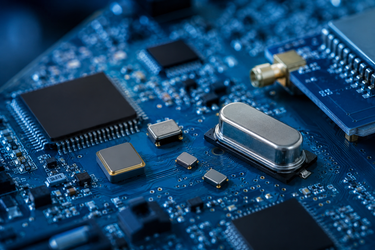
Understanding Phase Noise and Jitter in Crystal Oscillators for IoT Devices
Phase noise and jitter are two critical indicators of crystal oscillator performance. Lower phase noise generally produces lower integrated jitter, helping IoT devices achieve more reliable wireless communication, improved synchronization accuracy, and better signal integrity. Understanding both parameters enables engineers to select the right timing solution for applications ranging from smart sensors to 5G infrastructure.
Reliable timing is the foundation of every connected device. Whether an IoT sensor transmits environmental data, a smart gateway synchronizes industrial equipment, or a 5G module exchanges high-speed signals, clock accuracy directly affects system performance. Among all timing parameters, phase noise crystal oscillator performance and oscillator jitter are two of the most important indicators. Understanding phase noise vs jitter helps engineers select the right low jitter oscillator for stable IoT timing solutions while improving wireless communication reliability and product longevity.
As IoT networks continue to expand, billions of devices require highly stable timing references. Industry research predicts that connected IoT devices will exceed 30 billion globally within the next few years, placing greater demands on synchronization accuracy, signal integrity, and power efficiency. Under these conditions, choosing the appropriate phase noise crystal oscillator becomes an essential design decision rather than simply a component selection.
What Are Phase Noise and Jitter in Timing Components?
Before selecting a timing device, engineers should first understand the relationship between phase noise and oscillator jitter.
| Term | Definition |
|---|---|
| Phase Noise | Frequency-domain fluctuations around the carrier signal, usually expressed in dBc/Hz. |
| Jitter | Time-domain variation of clock edge positions, usually measured in RMS picoseconds. |
| Low Jitter Oscillator | An oscillator designed to minimize timing uncertainty for high-speed digital and RF applications. |
Phase noise describes the short-term frequency fluctuations of an oscillator in the frequency domain. It is usually expressed in dBc/Hz at specific offset frequencies from the carrier. A phase noise crystal oscillator with lower phase noise produces a cleaner spectral output and minimizes unwanted sideband energy.
By contrast, oscillator jitter measures timing variations in the time domain. Instead of evaluating frequency stability over offset frequencies, jitter represents how much each clock edge deviates from its ideal position.
This distinction explains why discussions about phase noise vs jitter are common in oscillator design. Although they describe different characteristics, they are closely related because excessive phase noise contributes to higher integrated jitter over a defined bandwidth.
For example, communication systems often specify RMS jitter integrated from 12 kHz to 20 MHz.A well-designed low jitter oscillator helps reduce timing variations over the specified bandwidth, supporting reliable synchronization and cleaner signal transmission in high-speed networking, 5G infrastructure, and IoT applications. Some commercial SPXO products even report integrated phase jitter as low as tens of femtoseconds under optimized operating conditions.
Why does this matter?
A timing component with excellent frequency accuracy may still perform poorly if its phase noise or jitter exceeds system requirements. For RF communication, high-speed networking, and precision sensing, timing quality often determines overall system performance more than nominal frequency tolerance alone.
In practical engineering, evaluating phase noise crystal oscillator performance together with oscillator jitter provides a more complete understanding of timing quality than considering either parameter alone.
How High Jitter Degrades IoT and Wireless Communications
Many engineers focus primarily on frequency accuracy, but oscillator jitter can have an equally significant impact on overall system performance.
In IoT devices, timing errors influence nearly every subsystem, including wireless transceivers, microcontrollers, sensors, synchronization circuits, and data converters. Excessive oscillator jitter introduces uncertainty into clock edges, reducing signal quality and increasing communication errors.
For wireless protocols such as Wi-Fi, Bluetooth, Zigbee, LoRa, and cellular IoT, poor clock stability may result in:
- Reduced receiver sensitivity
- Higher bit error rates
- Lower modulation accuracy
- Increased packet retransmissions
- Higher power consumption
As communication speeds increase, the impact becomes even more pronounced. Modern 5G infrastructure, edge computing equipment, and industrial gateways require extremely clean reference clocks because small timing deviations accumulate throughout the signal chain.
This is why designers increasingly compare phase noise vs jitter during component selection. A phase noise crystal oscillator with lower close-in noise generally produces cleaner clock signals, helping serializers, deserializers, RF front ends, and high-speed processors maintain reliable synchronization.
According to industry testing, every additional picosecond of clock jitter can noticeably reduce the effective number of bits (ENOB) of high-speed analog-to-digital converters, particularly at higher input frequencies. This makes low-jitter clock sources essential for precision data acquisition systems.
High jitter also affects analog performance. In high-speed ADCs and DACs, sampling uncertainty directly reduces signal-to-noise ratio (SNR) and limits achievable resolution. Consequently, selecting a low jitter oscillator is critical for applications involving precision measurement, industrial automation, and smart sensing.
For long-life IoT deployments, improved IoT timing solutions also contribute to reduced maintenance costs because stable clocks help maintain communication reliability throughout the product lifecycle.
Top Low-Jitter Oscillator Solutions for 5G and Smart Devices
Selecting the appropriate low jitter oscillator depends on application requirements, operating environment, interface type, and performance targets.
| Oscillator Type | Typical Application | Jitter Performance |
|---|---|---|
| SPXO | General IoT devices | Low |
| TCXO | Outdoor IoT | Very Low |
| VCXO | Communication equipment | Low |
| OCXO | Base stations | Ultra Low |
Standard packaged crystal oscillators (SPXOs) remain one of the most widely adopted solutions due to their balance between cost, stability, and integration simplicity. Many modern SPXO products are specifically optimized for lower integrated jitter while maintaining compact package sizes and low power consumption.
For networking, optical communication, AI hardware, and 5G equipment, differential output oscillators supporting LVDS or LVPECL interfaces often provide superior signal integrity. Several manufacturers offer devices with integrated RMS jitter below one picosecond across commonly specified bandwidths, making them suitable for demanding communication systems.
Temperature-compensated crystal oscillators (TCXOs) are another important category within advanced IoT timing solutions. By compensating frequency drift across temperature changes, TCXOs improve stability in outdoor sensors, automotive electronics, asset tracking devices, and industrial control systems. Some TCXO families additionally emphasize low phase noise characteristics for RF applications.
When selecting a phase noise crystal oscillator, engineers should evaluate several parameters simultaneously:
- RMS jitter specification
- Phase noise performance
- Frequency stability
- Supply voltage sensitivity
- Operating temperature range
- Aging characteristics
- Output format (CMOS, LVDS, LVPECL, HCMOS)
Instead of focusing on a single specification, the best IoT timing solutions balance electrical performance, environmental robustness, and long-term reliability according to the application's communication requirements.
How Manufacturers Test and Measure Oscillator Performance
Accurate measurement is essential for verifying phase noise crystal oscillator quality and ensuring consistent production performance.
Manufacturers typically evaluate phase noise using specialized phase noise analyzers or spectrum analyzers capable of measuring carrier noise at various frequency offsets. Test results generate phase noise plots that illustrate oscillator behavior from close-in offsets to wider frequency ranges.
For oscillator jitter, engineers generally perform time-domain analysis using high-performance oscilloscopes or dedicated jitter analyzers. RMS jitter values are commonly calculated over standardized integration bandwidths, allowing fair comparison between different oscillator products.
Additional qualification tests often include:
Frequency stability over temperature
Voltage sensitivity testing
Aging evaluation
Start-up time verification
Mechanical shock and vibration testing
Environmental reliability validation
Many manufacturers also conduct accelerated life testing to verify long-term stability under harsh operating conditions. These evaluations are particularly important for automotive electronics, industrial automation, medical equipment, and infrastructure applications where uninterrupted timing performance is required.
When reviewing datasheets, engineers should remember that phase noise vs jitter represents complementary performance metrics rather than competing specifications. Understanding both allows more accurate comparison between available low jitter oscillator products.
Comprehensive testing ensures that selected IoT timing solutions continue delivering stableg clock sinals throughout the expected service life, even under changing environmental conditions.
Conclusion
As connected devices become faster and more intelligent, clock quality has become a key factor affecting wireless reliability, signal integrity, and overall system performance. Understanding the relationship between phase noise crystal oscillator performance and oscillator jitter enables engineers to make informed design decisions. Rather than viewing phase noise vs jitter as interchangeable concepts, both should be evaluated together when selecting a low jitter oscillator for modern IoT timing solutions.
For engineers seeking reliable timing components, Q Crystal offers a broad portfolio of crystal oscillators designed for communications, networking, industrial electronics, and IoT applications. Its low-jitter oscillator solutions combine compact packaging, stable performance, and rigorous quality control, making them a practical choice for demanding timing designs.
Frequently Asked Questions
Is phase noise the same as jitter?
No. Phase noise is measured in the frequency domain, while jitter describes timing variations in the time domain.
What causes oscillator jitter?
Power supply noise, temperature variation, PCB layout, and oscillator design all contribute to jitter.
Which oscillator is best for IoT devices?
Most IoT devices use low jitter SPXO or TCXO depending on environmental requirements.

Contact
Official Chinese website:www.q-crystal.com.cn
Satisfaction quality, Just-in-time service, and Key-cost offering
©2026 SJK All Rights Reserved.