



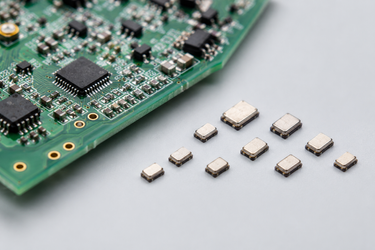
The Trend Towards Miniaturization: Selecting Ultra-Compact SMD Crystals
As electronic devices continue to become smaller, selecting the right ultra-compact SMD crystal has become a critical design decision. For most wearable devices, IoT modules, and portable electronics, engineers generally choose package sizes such as SMD crystal 3225, 2016, or 1612 quartz crystal based on available PCB space, frequency stability, and environmental requirements. Understanding the advantages and trade-offs of each package helps improve both product reliability and long-term performance.
Engineers today must evaluate multiple package options, understand the physical limitations of quartz resonators, and ensure that ultra-small devices can withstand demanding operating environments. This guide explores the latest trend toward miniaturization and explains how to choose the right 1612 quartz crystal, miniaturized crystal oscillator, or other wearable timing components for modern electronic designs.
Why Wearables and Smart Devices Demand Smaller Crystals
The global wearable electronics market continues to expand as consumers expect devices that are thinner, lighter, and more power-efficient. Smartwatches, fitness trackers, Bluetooth earbuds, smart rings, and healthcare monitoring devices all rely on precise timing circuits while offering increasingly compact designs.
Every electronic system requires a stable clock source. Whether it is a microcontroller, wireless communication module, or sensor, timing accuracy directly affects overall system performance. As PCB layouts become denser, engineers increasingly choose compact timing solutions such as SMD crystal 3225 and 1612 quartz crystal packages to maximize available board space.
Miniaturization offers several important advantages:
- Improved flexibility for optimizing internal component layouts
- Reduced overall device size and weight
- Improved flexibility for high-density PCB layouts
- Better integration within compact consumer electronics
- Lower material usage in certain designs
For wearable devices, reducing component height is equally important. A low-profile miniaturized crystal oscillator helps manufacturers design thinner products without sacrificing timing accuracy.
In wireless applications such as Bluetooth Low Energy (BLE), Wi-Fi, GPS, and Zigbee, stable frequency generation remains essential. Compact wearable timing components enable these systems to maintain reliable communication while meeting strict space limitations.
According to IDC, worldwide shipments of wearable devices continue to grow steadily, with hundreds of millions of units shipped annually. At the same time, PCB space within many wearable products has continued to decrease, making ultra-compact timing components increasingly important for product designers.
Popular Compact Sizes Explained: 3225, 2016, and 1612
The evolution of quartz crystal packaging has introduced increasingly smaller surface-mount options. Understanding the differences between these packages helps engineers make appropriate design decisions.
SMD Crystal 3225
The SMD crystal 3225 package measures approximately 3.2 × 2.5 mm and remains one of the industry's most widely adopted formats.
It offers an excellent balance between:
- Frequency stability
- Mechanical robustness
- Manufacturing yield
- Cost efficiency
Because of these advantages, SMD crystal 3225 devices are commonly used in industrial control systems, automotive electronics, consumer devices, networking equipment, and communication modules.
Compared with larger package formats, the SMD crystal 3225 delivers a balanced combination of electrical performance, mechanical durability, and manufacturing efficiency across a wide frequency range.
2016 Package
The 2016 package (2.0 × 1.6 mm) further reduces the component footprint.
This size is commonly selected for:
- Smart watches
- Portable medical equipment
- Wireless sensors
- GPS modules
- IoT nodes
The smaller package allows designers to increase component density while maintaining good frequency performance.
However, engineers must carefully consider PCB layout, solder joint quality, and mechanical stress, as these factors become increasingly important as package size decreases.
1612 Quartz Crystal
The 1612 quartz crystal package, measuring only 1.6 × 1.2 mm, represents one of today's most compact quartz timing solutions.
The 1612 quartz crystal is particularly suitable for compact electronic products that demand reliable timing performance within a very limited installation area, including:
- Bluetooth earbuds
- Smart rings
- Hearing aids
- Medical wearables
- Ultra-compact IoT devices
Despite its tiny dimensions, a modern 1612 quartz crystal can still provide stable frequency output suitable for many low-power embedded systems.
Choosing a 1612 quartz crystal is particularly beneficial when every square millimeter of PCB area contributes to improved product functionality or battery capacity.
| Package | Typical Applications | Main Advantage |
|---|---|---|
| SMD Crystal 3225 | Industrial Control | Stable Performance |
| 2016 | IoT | Smaller PCB |
| 1612 Quartz Crystal | Wearables | Ultra Compact |
Engineering Challenges in Miniaturizing Quartz Resonators
Although miniaturization creates obvious benefits, reducing crystal size also introduces significant engineering challenges.
Reduced Resonator Volume
Quartz resonators depend on carefully controlled mechanical vibration.
As package dimensions shrink, the quartz blank itself becomes thinner and smaller. This reduced physical size makes manufacturing precision increasingly important because even slight dimensional variations may influence frequency accuracy.
Manufacturers therefore employ advanced photolithography, precision machining, and automated inspection technologies to achieve consistent production quality.
Mechanical Fragility
Ultra-small packages naturally become more susceptible to external mechanical forces.
Shock during assembly, PCB bending, or thermal expansion may introduce stress that affects resonator performance.
For this reason, many modern miniaturized crystal oscillator products incorporate optimized package structures designed to reduce stress transmission.
Thermal Stability
Smaller packages contain less material, making them more sensitive to temperature changes.
Engineers must carefully optimize:
- Quartz cut angle
- Electrode design
- Package materials
- Sealing technology
These improvements help maintain frequency stability over wide operating temperature ranges.
Low Power Requirements
Battery-powered devices require extremely efficient timing solutions.
Many wearable products spend most of their operating life in low-power sleep modes. The selected small crystal oscillator must therefore maintain stable oscillation while consuming minimal current.
This balance between low power consumption and reliable startup remains one of the most important design considerations.
Ensuring Reliability and Stability in Ultra-Small Packages
Miniaturization should never come at the expense of long-term reliability.
When evaluating compact timing devices, engineers should consider several critical performance factors.
Frequency Stability
Frequency stability directly affects wireless communication accuracy, processor timing, and sensor synchronization.
Manufacturers typically specify stability across operating temperature ranges, often expressed in parts per million (ppm). Selecting the appropriate specification depends on the application's environmental conditions and precision requirements.
Aging Performance
Quartz crystals naturally experience small frequency shifts over time.
Reducing long-term aging requires careful control of raw materials, manufacturing accuracy, and production consistency, all of which contribute to more stable frequency performance throughout the product's service life.
Lower aging rates contribute to longer service life and reduced maintenance requirements.
Environmental Reliability
Compact devices frequently operate under demanding conditions.
Reliability testing often follows internationally recognized standards and may include temperature cycling, mechanical shock, vibration resistance, solderability, and humidity testing. For automotive applications, many timing components are additionally evaluated according to AEC-Q200 qualification requirements to verify long-term durability under harsh environments.
- Temperature cycling
- High-temperature storage
- Humidity exposure
- Mechanical shock
- Random vibration
- Solder heat resistance
These evaluations help verify that a miniaturized crystal oscillator can maintain stable performance throughout the product lifecycle.
Manufacturing Consistency
Consistent production quality becomes increasingly important as package size decreases.
Automated manufacturing systems, precision inspection equipment, and statistical quality control all contribute to higher production consistency for SMD crystal 3225, 1612 quartz crystal, and other compact timing products.
Design engineers should also review supplier capabilities, including manufacturing experience, quality certifications, and process control, when selecting timing components for high-volume production.
Selecting the Right Package
There is no universally "best" package size. Instead, selecting an ultra-compact SMD crystal requires balancing several design considerations rather than focusing on size alone. Engineers should evaluate available PCB space, electrical specifications, operating temperature, manufacturing compatibility, and long-term reliability before making a final decision.
- Available PCB space
- Required frequency range
- Operating temperature
- Power consumption
- Shock and vibration resistance
- Manufacturing process compatibility
- Long-term reliability expectations
In many industrial and communication applications, SMD crystal 3225 remains a popular choice because it provides an excellent balance between compact dimensions, mechanical strength, and stable electrical performance. For highly integrated wearable electronics and miniature IoT devices, a 1612 quartz crystal may be a better solution when PCB space is extremely limited.
Designers should also compare parameters such as frequency stability, load capacitance, equivalent series resistance (ESR), and aging characteristics. Reviewing these specifications together helps ensure that the selected miniaturized crystal oscillator or quartz crystal meets both performance and reliability requirements throughout the product lifecycle.
For many industrial and consumer applications, the SMD crystal 3225 continues to provide an excellent balance between compact size and robust performance. Meanwhile, the 1612 quartz crystal has become increasingly attractive for highly integrated wearable products where every millimeter counts.
Final Thoughts
The continued trend toward smaller electronics is driving rapid innovation in quartz timing technology. Whether selecting an SMD crystal 3225, 1612 quartz crystal, small crystal oscillator, or other wearable timing components, engineers should evaluate package size alongside frequency stability, environmental reliability, manufacturing consistency, and long-term performance. A well-informed component selection helps ensure that compact electronic products remain accurate, efficient, and dependable throughout their service life.
When evaluating suppliers for ultra-compact timing components, manufacturers with extensive experience in quartz frequency-control technology, strict quality management systems, and broad product portfolios can better support long-term product development. As an established manufacturer specializing in SMD crystals and frequency-control solutions, Q-Crystal provides a wide selection of compact package options together with engineering support for diverse electronic applications.
Frequently Asked Questions
What is the advantage of an ultra-compact SMD crystal?
Ultra-compact SMD crystals help reduce PCB size, allowing designers to integrate more functions into smaller electronic devices. They are widely used in wearable electronics, IoT modules, medical devices, and portable consumer products where board space is limited. Modern manufacturing processes also enable these compact components to maintain excellent frequency stability and long-term reliability.
Is a 1612 quartz crystal always better than an SMD crystal 3225?
Not necessarily. A 1612 quartz crystal provides a much smaller footprint, making it ideal for highly integrated wearable devices. However, an SMD crystal 3225 generally offers greater mechanical robustness, easier assembly, and may provide a wider range of frequency options. The best choice depends on PCB space, environmental conditions, and overall system requirements rather than package size alone.
How can engineers improve the reliability of a small crystal oscillator?
Reliability depends on several design factors, including proper PCB layout, appropriate soldering profiles, suitable operating temperatures, and selecting components from experienced manufacturers. Following the supplier's recommended land pattern and avoiding excessive mechanical stress during assembly can also help maintain the long-term stability of a small crystal oscillator.
Which package size is best for wearable devices?
There is no universal answer. The ideal package depends on the available PCB space, operating environment, frequency requirements, and manufacturing process. While 1612 quartz crystal packages are commonly selected for extremely compact wearables, SMD crystal 3225 remains a preferred option for many applications requiring higher mechanical robustness and manufacturing flexibility.

Contact
Official Chinese website:www.q-crystal.com.cn
Satisfaction quality, Just-in-time service, and Key-cost offering
©2026 SJK All Rights Reserved.